
When companies talk about AI returns, the conversation almost always starts in the same place: cost...
The Leadership Gap Behind Stalled AI Initiatives
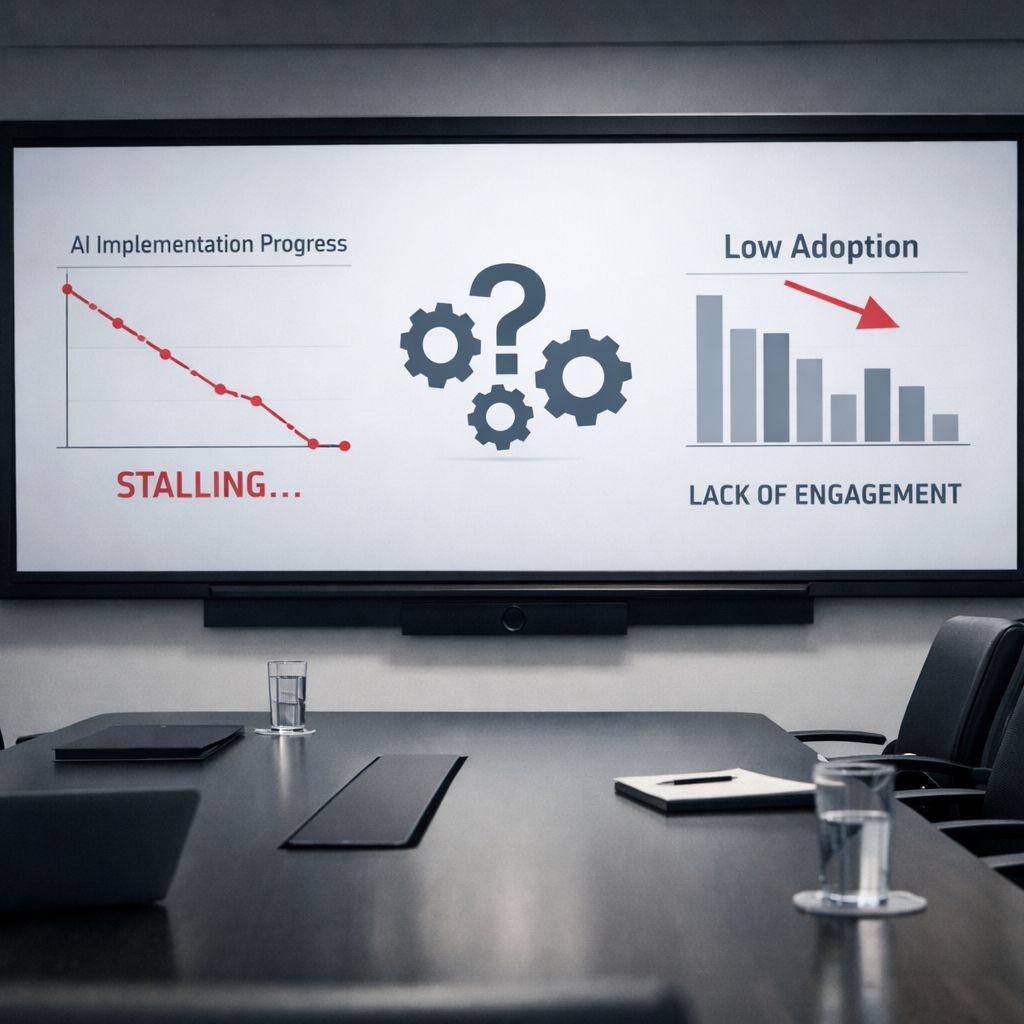
AI initiatives rarely stall because the technology fails.
More often, they stall for a much quieter reason long before any system goes live or any software is deployed. The hesitation shows up in people. In the questions they don’t ask. In the tools they don’t quite use. In the momentum that never fully builds.
We’ve seen strong AI initiatives slow down even when the technical pieces were solid. The problem usually appeared early, at the moment when the organization introduced AI without explaining what it actually meant for the people doing the work.
When that gap goes unaddressed, progress becomes fragile.
Where Momentum Starts to Fade
On paper, many AI projects look well-designed. There’s a clear use case, a capable platform, and leadership support at the kickoff. Yet months later, the initiative hasn’t moved beyond a pilot, or usage remains inconsistent across teams.
The warning signs tend to be subtle. Teams aren’t resistant in obvious ways. Instead, they hesitate. They wait for more clarity. They revert to familiar processes when things get busy. Leadership starts wondering why adoption is slower than expected.
This isn’t a technical failure. It’s an alignment issue.
When employees aren’t sure why AI is being introduced, or how it affects their role, uncertainty fills the space. And uncertainty naturally slows things down.
AI Adoption Is a Human Process
AI is often framed as a systems problem—models, integrations, data pipelines. But adoption lives somewhere else entirely.
People want to understand the intention behind the change. They want to know what problem the organization is trying to solve, how success will be measured, and what this shift means for their day-to-day work. When those questions aren’t addressed, even capable teams pull back.
That resistance doesn’t usually look like pushback. It looks like quiet disengagement.
This is why adoption ends up being the deciding factor in whether AI creates value or simply becomes another stalled initiative. You can build something technically sound, but if people feel unsure or threatened, the momentum never fully takes hold.
Why Leadership Matters More Than the Tooling
At the center of most stalled AI initiatives is a leadership gap.
Not a lack of interest, but a lack of ownership.
When AI doesn’t have a clear owner—someone accountable for outcomes, adoption, and direction—it drifts. It becomes an experiment instead of a strategy. Teams receive mixed signals, and priorities shift.
Strong leadership creates stability. When leaders explain why the organization is moving in this direction, people have something steady to hold onto. When leaders take time to listen to where teams are struggling, adoption becomes a shared effort instead of a mandate.
This idea is explored further in Ajay’s piece, AI Only Works When Someone Owns It, which highlights how accountability often determines whether AI moves forward or stalls out.
The Communication Gap That Slows Everything Down
One of the most common missteps in AI initiatives is assuming that a single announcement is enough.
In reality, communication needs to evolve as the work evolves.
Early on, teams need context. Later, they need reassurance. Eventually, they need practical guidance grounded in real workflows. When leadership stays engaged throughout that process, uncertainty decreases, and confidence grows.
What’s often most valuable is creating space for honest conversations. When employees feel safe voicing confusion or concern, organizations surface obstacles early—before they become blockers. That feedback strengthens the initiative instead of slowing it down.
This is where real value starts to show up. Not just in metrics, but in how people talk about the Moving Beyond Deployment Toward Real Change
AI success isn’t measured by whether a system is live. It’s measured by whether it’s used.
That requires more than deployment. It requires alignment between leadership intent and operational reality. When AI is introduced without considering existing workflows, it often stays on the sidelines.
Organizations that see lasting impact tend to approach AI as an organizational change, not a technical rollout. They connect strategy to execution and revisit assumptions as teams begin using the tools.
This is where structured approaches make a difference. The OnTracAI solutions are designed to support that bridge—helping organizations align leadership vision with real-world adoption. Dedicated AI implementation and integration strategies ensure technology supports how people actually work, rather than forcing change without support.
Closing the Leadership Gap
The organizations that move forward don’t necessarily have better technology. They have a clearer direction.
They establish ownership early, communicate intent consistently, and treat adoption as something to be supported—not assumed. Leaders stay present, not just at kickoff, but throughout the adjustment period when questions and uncertainty naturally arise.
When adoption is treated as a signal rather than an afterthought, teams engage differently. AI stops feeling abstract or threatening and starts feeling useful.
The Real Driver of Momentum
Technology matters. There’s no denying that.
But momentum comes from people feeling grounded in where the organization is headed and why the change matters. When leaders take the time to explain the direction and invite teams into the process, adoption becomes something shared.
That’s when AI initiatives stop stalling—and start delivering real value.