A VP of Operations recently described an AI initiative that sounded impressive on paper.
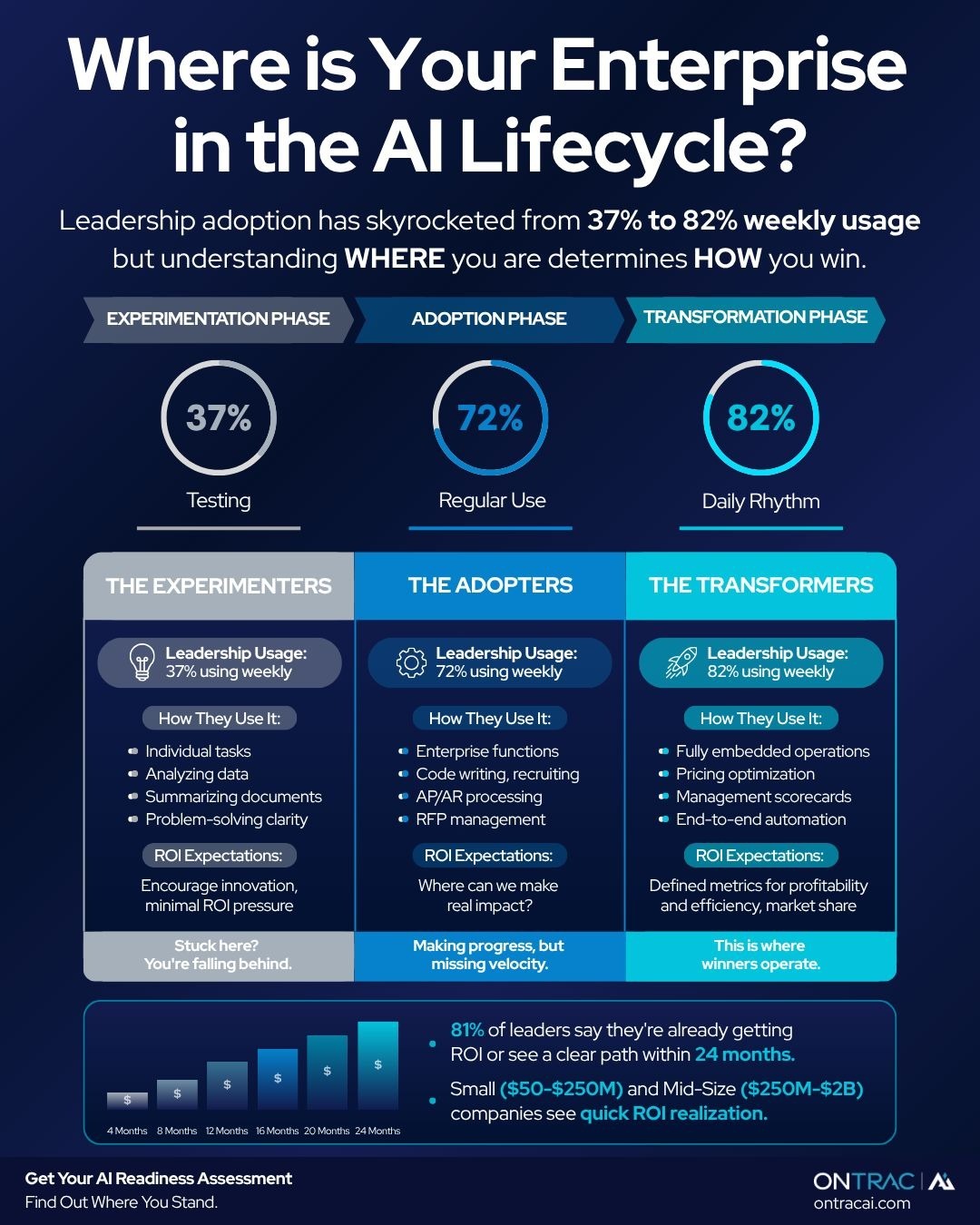
Over the past two years, executive adoption of AI has skyrocketed—from 37% weekly usage to 82%. Leaders are embracing AI solutions faster than any other technology in recent memory. But there’s a growing disconnect between AI usage and AI transformation.
A conversation with a VP of Operations captured the challenge well:
“We rolled out AI tools to the team eight months ago. Everyone uses them. But I still can’t point to a single process that has fundamentally changed the business.”
This isn’t unusual. In fact, this is the gap most enterprises currently operate within.
Teams are experimenting to maximize AI capabilities. Tools are everywhere. But the material impact—the kind that reshapes cost structure, accelerates growth, and lifts profitability—remains elusive. And in nearly every case, the issue isn’t adoption. Its adoption is in the wrong phase of the AI lifecycle.
To understand how organizations progress—and why so many stall—it helps to break the AI journey into three phases.
The Three Phases of the Enterprise AI Lifecycle
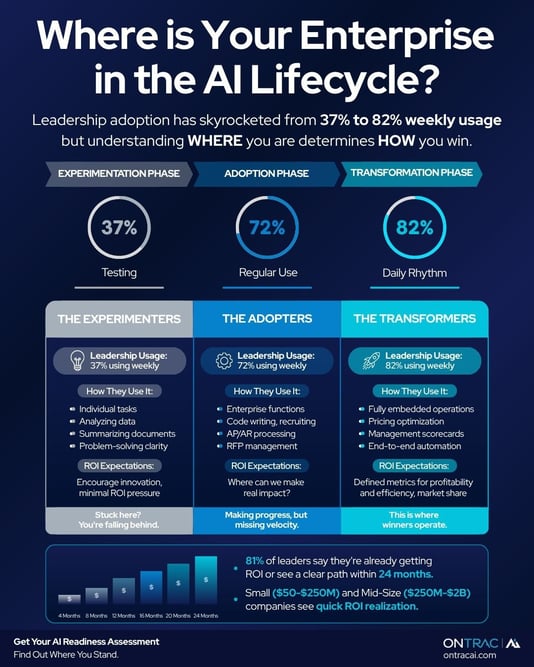
AI usage is rising across all industries, but usage alone doesn’t determine competitiveness. Where your organization sits in the lifecycle determines how AI affects your bottom line.
1. The Experimentation Phase (37% weekly usage)
Most organizations begin here—often without even realizing it.
Teams start exploring AI tools to support individual tasks:
- Improving email quality
- Getting problem-solving clarity
- Summarizing documents
- Analyzing data faster
It feels productive. It boosts morale. And there’s virtually no pressure to demonstrate ROI. This is the “try things out and see what sticks” era.
But here’s the warning: If the enterprise remains in this phase for too long, it risks falling behind competitors who move past experimentation and into measurable transformation. Learn how emerging AI capabilities can evolve beyond experimentation.
2. The Adoption Phase (72% weekly usage)
Usage levels jump dramatically— and so does organizational optimism.
AI extends beyond individual contributors and starts touching functional areas:
- Recruiting
- AP/AR processing
- RFP management
- Enterprise code generation
- Support workflows
Teams can feel the momentum. Leaders start asking better questions:
“Where can AI create real, measurable business impact?”
However, this is also where most organizations stall.
- They see increased productivity but not exponential value.
- They automate tasks, but not outcomes.
- They introduce tools, but not redesigned processes.
This phase creates the illusion of progress, but without the velocity.
3. The Transformation Phase (82% weekly usage)
Weekly usage only increases slightly from Phase 2—but the difference in business impact is dramatic.
In this phase, AI is not a tool. It’s an operating model.
Organizations begin to experience:
- Fully embedded AI workflows across operations
- Pricing optimization runs automatically
- Management scorecards generated in real time
- End-to-end automation of multi-step processes
- Defined metrics tied directly to efficiency, profitability, and customer satisfaction
This is the zone where winners operate.
Enterprises here unlock compounding value every month because AI solutions fuel speed, accuracy, quality, and decision-making at scale.
Where Most Enterprises Actually Sit Today
Despite rapid growth in leadership usage, most companies remain stuck between experimentation and adoption.
- They have the tools.
- Their teams use them.
- They believe they’re moving forward.
But they haven’t made the strategic shift needed to answer the fundamental question:
“Where does AI create transformational value in our business?”
Until that question is answered, most AI investment will remain incremental rather than exponential, focused on improving tasks rather than transforming processes.
Why Organizations Get Stuck Between Phases
Based on industry data and hundreds of executive conversations, three obstacles repeatedly surface:
AI Is Treated Like a Productivity Booster
If AI is viewed as a way to “help people work faster,” the ceiling is low.
Transformation starts when leaders instead ask:
“How do we redesign workflows so AI handles the work itself?”
No Clear AI Strategy or Ownership
Tools are deployed widely, but no one owns the roadmap. Teams innovate independently, but without coordination or governance.
Without a unified strategy, adoption plateaus.
No Defined Metrics for AI Impact
Experimentation produces anecdotes. Transformation produces scoreboards.
Enterprises unlock maximum value when they tie AI to:
- Lower operational cost
- Higher revenue velocity
- Increased margin
- Faster cycle times
- Greater employee satisfaction
Until these metrics exist, AI will feel exciting—without being transformative.
The Real Question: Where Is Your Enterprise Today?
Not where you hope to be. Not where your tool usage suggests you might be. But where you actually operate today.
- Are you experimenting?
- Are you adopting?
- Are you transforming?
Every phase has value, but only one delivers a competitive advantage, and only one becomes a true moat.
What’s Stopping You From Moving to the Next Phase?
For most organizations, the obstacles aren’t technical at all—they’re strategic. Many lack a clear ownership structure for AI, resulting in initiatives scattered across teams and a lack of unified direction. Others haven’t established enterprise-wide AI priorities, resulting in isolated projects that never scale.
There’s often uncertainty about where AI can deliver measurable ROI, making it difficult to justify investment or redesign workflows. Some companies move forward without an accurate transformation roadmap, causing efforts to stall before they gain traction.
In many cases, the tools being adopted aren’t aligned with tangible business outcomes, preventing AI from creating meaningful impact.
The organizations that ultimately reach the Transformation Phase aren’t the ones who simply use AI more frequently. They’re the ones who rethink how AI fits into the architecture of their business—treating it not as an incremental upgrade, but as a foundational shift in how work gets done.
Usage Doesn’t Equal Transformation
Leadership adoption jumping from 37% to 82% is an incredible signal.
But usage is only the beginning.
The enterprises that win in 2025–2026 won’t be the ones using AI the most. They’ll be the ones who use AI to alter the mechanics of their business.
So ask your leadership team:
Which phase are we truly in—and what will it take to move to the next?
Because the companies that answer that question now will be the ones defining their industry in the next 24 months, if you're ready to determine which phase you're currently operating in and how to accelerate into the next one, our team can help.
Connect with us to start the conversation and learn about how we can help you grow your business through more efficient operations, simplification, and automation.