Over the past two years, executive adoption of AI has skyrocketed—from 37% weekly usage to 82%....

When companies talk about AI returns, the conversation almost always starts in the same place: cost reduction.
Cut hours. Reduce headcount. Automate tasks. Shrink expenses.
It sounds logical. AI is powerful, efficiency is measurable, and savings look good in board decks. But here’s the uncomfortable truth:
Leading with cost reduction is one of the fastest ways to sabotage AI adoption—and long-term ROI.
The data backs this up, and so does real-world experience.
What the High Performers Do Differently
A 2025 report from McKinsey highlights a clear divide between companies that achieve meaningful AI returns and those that don’t.
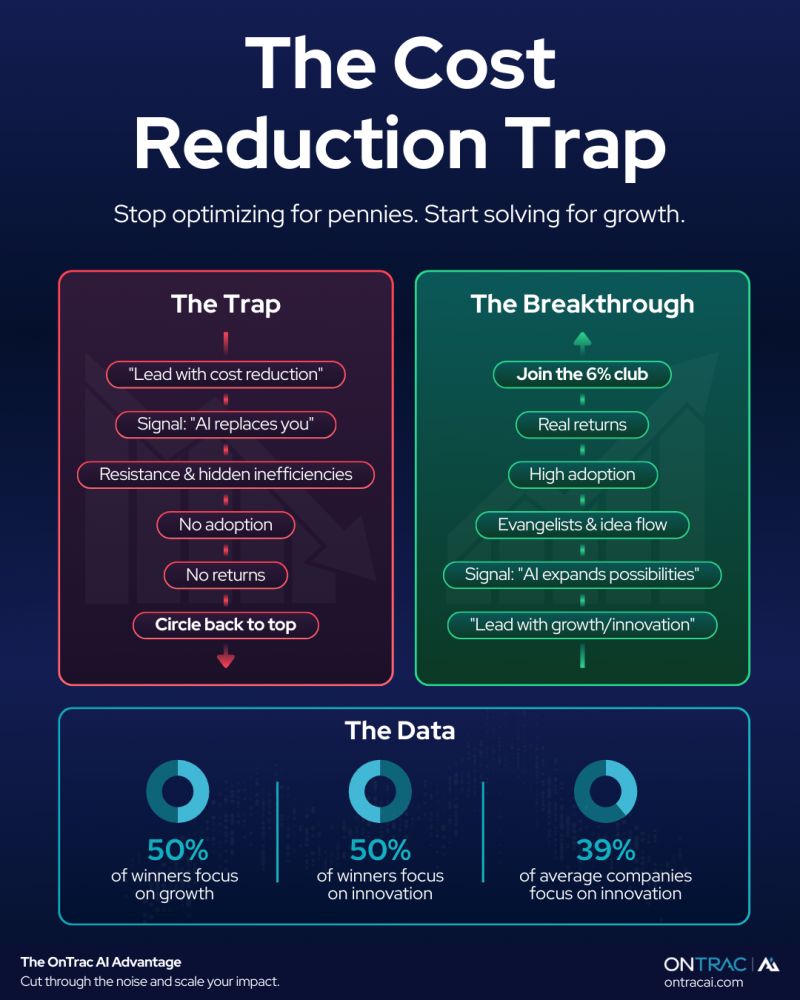
Among the small group of companies seeing real, material impact from AI, priorities consistently center on growth and innovation, not cost cutting. Roughly half of high performers cite growth as a primary objective, and half cite innovation.
Average companies look very different. Fewer than 40% point to innovation as a goal, and most frame AI first as an efficiency lever.
The pattern is clear.
Winners aren’t trying to squeeze pennies out of operations.
They’re trying to expand what’s possible.
Why Cost Reduction Is a Dangerous Starting Point
Cost reduction isn’t wrong. It’s just the wrong place to begin.
When leaders position AI primarily as a way to reduce costs, they send an unspoken message: AI is here to replace you.
That signal changes behavior almost immediately. People become cautious. They stop surfacing inefficiencies. Teams protect their turf instead of collaborating. Adoption slows—or quietly stalls altogether.
AI initiatives rarely fail because employees don’t understand the technology. They fail because employees don’t trust the intent behind it.
Fear Is the Enemy of Adoption
AI only creates value when people actually use it.
Once fear enters the system, adoption collapses. Process knowledge stays hidden. Opportunities never make it into planning discussions. The very savings leaders hope to unlock remain buried behind human behavior.
Ironically, cost-focused AI programs often deliver less efficiency—not more—because resistance prevents scale.
Growth and Innovation Create Energy
Now compare that with organizations that lead with growth or innovation.
When the message shifts to “AI helps us do things we couldn’t do before,” something changes. People begin offering ideas instead of withholding them. Teams experiment without fear. Employees become advocates rather than blockers.
AI stops feeling like surveillance and starts feeling like leverage.
This is why high-performing organizations don’t begin their AI journey with large, disruptive cuts. They begin with wins that make work meaningfully better.
What to Do Instead
The most effective AI programs start with problems that improve daily work—not just the balance sheet.
Better starting points often sound like this:
- Can AI help us respond to RFPs faster so we stop losing deals we should win?
- Can it surface pricing or upsell opportunities we consistently miss?
- Can it eliminate the manual process everyone complains about but nobody has time to fix?
These aren’t abstract innovation goals. They’re concrete, painful, and already understood across the organization.
Your Team Already Knows Where AI Should Start
You don’t need a consultant to identify strong early AI opportunities. Your team already knows where the friction lives.
It’s in the repetitive research, the data entry that takes hours, the reconciliations that keep people late, and the workarounds no one enjoys maintaining.
Fixing these issues creates momentum—and momentum is far more valuable early on than maximum savings.
Momentum First, Transformation Later
When teams experience AI as something that removes frustration instead of colleagues, trust builds quickly.
Adoption increases. Leaders gain credibility. New ideas surface without being forced.
Only after that momentum exists should organizations move into larger, more disruptive transformations—including cost reduction. At that stage, resistance is lower and outcomes are stronger because trust is already in place.
From Cost Cutting to Value Creation
At OntracAI, this pattern shows up again and again. The companies that struggle with AI are often the ones that rush too quickly to cut costs. The companies that succeed start by expanding capability.
AI works best when it’s introduced as an enabler, not a threat.
👉 Explore practical AI solutions designed to build momentum, not fear, here.
Why Failure Still Matters
One final counterintuitive truth: healthy AI programs don’t get everything right on the first try.
Iteration and occasional failure are part of building real capability. Avoiding risk entirely often means avoiding learning altogether. That idea is explored further in our article If Your AI Never Fails, You’re Doing It Wrong.
The Bottom Line
Cost reduction matters—but leading with it sends the wrong signal at the wrong time.
The companies seeing real AI returns aren’t starting with cuts. They’re starting with growth, innovation, and problems people genuinely want solved.
Fix what frustrates your teams.
Create energy.
Build evangelists.
Then—and only then—use AI to transform the business at scale.
Because AI doesn’t unlock value by making people cheaper.
It unlocks value by making people more capable.