Last week at NADA, I found myself walking between two completely different conversations.

There’s a pattern that shows up again and again when organizations start working with AI.
The technology is promising. The early conversations feel energizing. A pilot is launched. Teams are curious.
And then, slowly, momentum fades.
Not because the technology fails. Not because the idea was wrong.
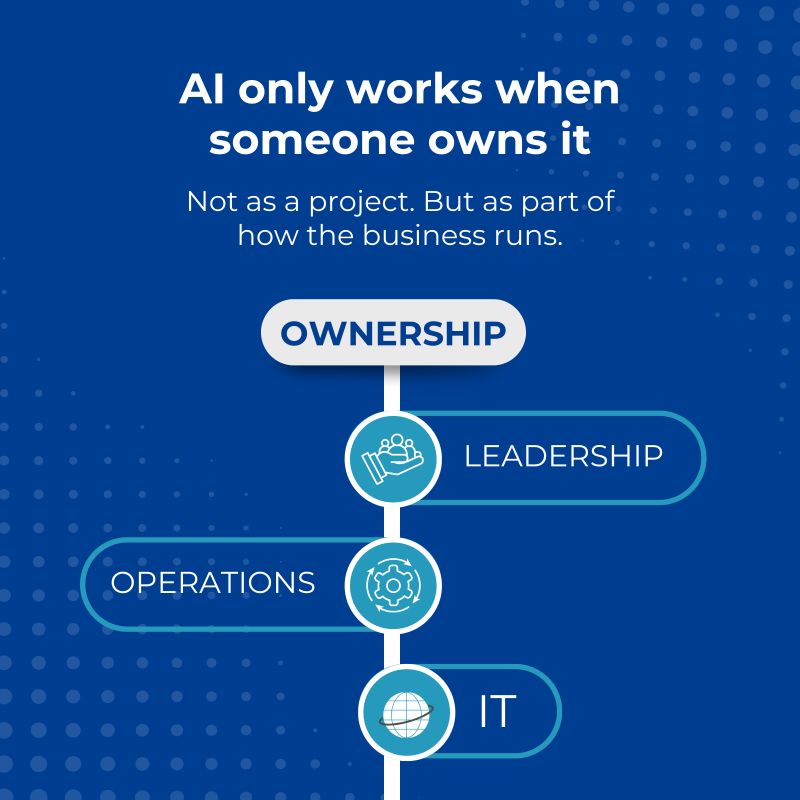
But because no one truly owns it.
AI initiatives rarely succeed when they exist as experiments or side projects. They need clear ownership — not just technically, but operationally and strategically. Without that, even strong ideas struggle to move beyond early stages.
The Problem With Treating AI as “Someone Else’s Project”
Many companies begin their AI journey by creating innovation labs or assigning exploration to a small technical team. It feels logical. AI seems complex, and naturally organizations assume it belongs to IT or data science.
But this structure creates distance.
When AI is isolated from day-to-day operations, teams outside the initiative see it as separate from their work. Adoption becomes optional. Questions remain unanswered. The initiative slowly becomes another experiment rather than a driver of change.
Other organizations make a different mistake. They treat AI as a strategic exercise — something discussed at leadership offsites or framed in high-level presentations — but never translated into operational ownership.
In both cases, the outcome is similar: momentum stalls.
AI doesn’t succeed because it exists. It succeeds because someone is accountable for making it work inside real workflows.
Ownership Is Not the Same as Sponsorship
Many initiatives have executive sponsors. Fewer have true owners.
A sponsor approves budgets, communicates vision, and supports the initiative publicly. Ownership, however, looks different. Ownership means being responsible for adoption, alignment, and outcomes.
An owner asks:
- How will teams actually use this?
- What obstacles are slowing adoption?
- Are we solving the right problem?
Without someone asking these questions consistently, AI becomes theoretical. Teams may test tools, but integration into daily work remains incomplete.
Ownership turns AI from an experiment into an operational priority.
Why Leadership Involvement Changes Everything
One of the biggest misconceptions about AI is that success depends primarily on technology selection.
In reality, leadership behavior often determines the outcome more than the platform itself.
When leaders actively engage — explaining the purpose behind AI initiatives and staying involved beyond the kickoff — teams interpret the work differently. AI stops feeling like an external project and starts feeling like part of the organization’s direction.
Dennis Hodges from Inteva Products captured this idea clearly: “You can’t be on the sidelines. You have to jump in and do it.”
Leadership presence signals commitment. Commitment builds trust. And trust accelerates adoption.
The Quiet Failure Mode: Shared Responsibility Without Accountability
Organizations sometimes assume that cross-functional collaboration means shared ownership. While collaboration is essential, shared responsibility without clear accountability often leads to diffusion.
Everyone supports the initiative, but no one drives it forward.
This is especially common when AI spans multiple departments. Marketing sees value. Operations sees potential. IT manages the technology. But without a defined owner, decisions slow down and progress becomes fragmented.
Ownership does not mean centralization of all work. It means clarity around who ensures alignment across teams and keeps momentum alive.
AI Adoption Is Organizational, Not Technical
Companies seeing real results from AI tend to approach it differently. They recognize that AI is less about implementing tools and more about evolving how work gets done.
Ownership helps bridge that gap.
When leaders treat AI as part of how the business runs — rather than a special initiative — adoption becomes embedded into everyday decisions. Teams begin experimenting more confidently because direction is clear.
This is closely connected to another common challenge explored in The Leadership Gap Behind Stalled AI Initiatives, where unclear leadership alignment slows progress even when the technical foundation is strong.
Together, ownership and leadership clarity create the conditions where AI can move beyond pilots and into meaningful transformation.
What Ownership Looks Like in Practice
Ownership does not require creating entirely new organizational structures. Instead, it often involves redefining roles and expectations.
In practice, ownership shows up through consistent behaviors:
A clear leader connects AI initiatives to business outcomes, rather than treating them as standalone experiments. Communication continues throughout implementation, helping teams understand both the “why” and the “how.” Decisions about prioritization, adoption barriers, and measurement stay visible instead of being deferred.
Perhaps most importantly, ownership ensures that AI remains grounded in real problems. The focus shifts from exploring possibilities to delivering results.
From Innovation to Integration
Many organizations get stuck in perpetual experimentation.
Pilots are launched, lessons are learned, but scaling never happens. This usually signals a gap between innovation and integration.
Ownership helps close that gap.
When someone is responsible for moving initiatives from testing into operational workflows, AI stops living on the margins. Teams begin aligning processes, refining expectations, and adjusting metrics to reflect new ways of working.
Structured approaches can help accelerate this transition. The OnTracAI solutions are designed to support organizations moving from exploration into practical adoption, while ROI and implementation clarity provide the operational framework leaders need to sustain progress.
Why Accountability Drives Real Transformation
Companies that see meaningful outcomes from AI tend to share one trait: they treat AI as a leadership and accountability challenge rather than a technical experiment.
Ownership creates momentum because it reduces ambiguity. Teams know where to go with questions. Priorities remain visible. Decisions move faster.
Without ownership, initiatives drift. With ownership, they evolve.
The difference is subtle but powerful.
Final Thoughts
AI doesn’t fail because the technology isn’t ready. More often, it fails because no one truly owns the journey from idea to adoption.
Organizations that succeed recognize this early. They move beyond treating AI as an innovation exercise and instead embed it into leadership accountability and operational reality.
When someone owns the work — not as a side project, but as part of how the business runs — AI stops being theoretical.
That’s when real transformation begins.