Case Studies: How We Integrated AI in Manufacturing
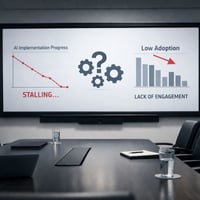
AI in manufacturing doesn’t fail because the technology is immature. It fails when it’s applied too early, too broadly, or without respect for how work actually gets done.
Over the past several years, we’ve seen that the most successful AI projects in manufacturing share a few traits. They start with the process, not the models. They focus on a specific operational problem. They’re designed to fit into existing systems instead of forcing a full rebuild.
The following case studies show how AI was implemented in manufacturing environments to solve pricing, quoting, and cost-visibility challenges—without multi-year transformations or massive organizational disruption.
Starting with the Process, Not the Algorithm
Every successful AI implementation we’ve delivered in manufacturing began the same way: by understanding the process exactly as it exists today.
Before introducing AI or even automation, workflows must be repeatable. If a process is inconsistent, unclear, or overly dependent on tribal knowledge, automating it simply produces faster mistakes. That’s why our work typically starts by observing how teams perform their day-to-day tasks—sometimes literally watching screens and walking through decisions step by step.
Only after the process is sound do we introduce automation. Only after automation is stable do we introduce AI.
This “foundation first” approach allows AI to operate with context, guardrails, and traceability—three things manufacturers care deeply about.
Case Study 1: Fixing Cost Visibility in High-Volume Manufacturing
One global manufacturer came to us with a problem that looked small on paper but was enormous in practice.
Their sales and engineering teams routinely estimated product costs that didn’t match actual manufacturing costs. The discrepancy might be just a few cents per unit—but at millions of units, those cents turned into major financial exposure.
The challenge wasn’t a lack of data. It was fragmentation. Engineering data lived in CAD systems. Cost assumptions lived in spreadsheets. Finance had its own models. No one had a unified view.
The solution involved reverse-engineering actual production costs and aligning them against expected costs in near real time. Technical data—including complex CAD information—was analyzed and normalized into a centralized knowledge base. From there, role-specific dashboards were created so finance, engineering, and leadership could each see what mattered to them.
Natural language interaction was layered on top of the system, allowing users to ask questions of the data without needing to navigate multiple tools. Instead of hunting for numbers, teams could focus on decisions.
The result wasn’t just better reporting. It was faster course correction when costs drifted—and fewer surprises downstream.
Case Study 2: Real-Time Pricing and Quoting in Manufacturing
In another engagement, pricing was the bottleneck.
A global manufacturer’s pricing and quoting process took nearly six days from start to finish. During that time, engineering changes, material fluctuations, or tariffs could invalidate the quote before it was even delivered. The company estimated that slow pricing alone was costing them roughly 20 percent of monthly sales opportunities.
The goal wasn’t to replace human decision-making. It was to support it.
We built an AI-driven pricing model that continuously ingested real-time inputs such as regional data, socioeconomic factors, competitive positioning, and engineering changes. Sales teams could access pricing recommendations through a single dashboard, complete with an auditable trail showing how each recommendation was formed.
Instead of reacting days later, pricing teams could adjust immediately. Quotes became faster, more consistent, and more defensible.
The projected ROI for this initiative reached into the hundreds of millions of dollars, with a potential three to five percent increase in global sales—driven not by aggressive pricing, but by speed and accuracy.
Why COE as a Service Works in Manufacturing
Many of these projects were delivered through a Center of Excellence (COE) as a Service model.
Manufacturers often need high-value roles—solution architects, data scientists, program managers—but not permanently. COE as a Service allows organizations to access these capabilities when needed, without building a large internal team upfront.
More importantly, the COE is shaped around technology and outcomes rather than organizational silos. In one engagement, the COE initially supported finance workflows and later transitioned to HR onboarding. The core capabilities remained the same; the use cases evolved.
This flexibility allows manufacturers to move quickly while maintaining consistency and governance across projects.
Technology Should Follow the Problem
Our approach to AI in manufacturing is intentionally technology-agnostic.
We start by defining the problem, then evaluate what technology best fits—often leveraging what the client already owns. If a manufacturer is already using tools like UiPath, ABBYY, or Google’s AI platforms, we explore how far those can go before introducing something new.
In more complex environments, especially where workflows span systems like SAP and Oracle, we may recommend platforms designed to orchestrate across multiple technologies.
In some cases, pre-built solutions make sense—particularly when speed and cost are critical. The decision always comes down to tradeoffs, not trends.
What These Case Studies Have in Common
Across manufacturing environments, successful AI implementations tend to share a few characteristics:
- A clearly defined operational problem
- Strong process foundations before automation or AI
- Tight integration with existing systems
- Transparency and explainability in outputs
- A delivery model that prioritizes speed and flexibility
AI works best when it supports how manufacturing teams already operate—rather than forcing them to adapt to the technology.
From Use Case to Competitive Advantage
Manufacturers don’t need AI everywhere to see impact. They need AI in the right places.
When implemented thoughtfully, AI becomes less about experimentation and more about operational leverage—faster pricing, clearer cost visibility, and better decisions made closer to real time.
Explore our AI solutions and discover how these capabilities fit into a broader implementation strategy. For a deeper dive into pricing and quoting specifically, see how AI is changing the pricing and quoting for manufacturing.