Using ChatGPT Doesn’t Make You an AI-Powered Company We hear this constantly:

A lot of companies are “doing AI” right now. Tools are everywhere. Pilots are everywhere. Internal demos are everywhere.
But here is the uncomfortable reality: only a tiny slice of organizations has reached anything you’d call AI maturity. In other words, AI is present, but it’s not dependable, scalable, and consistently tied to business outcomes.
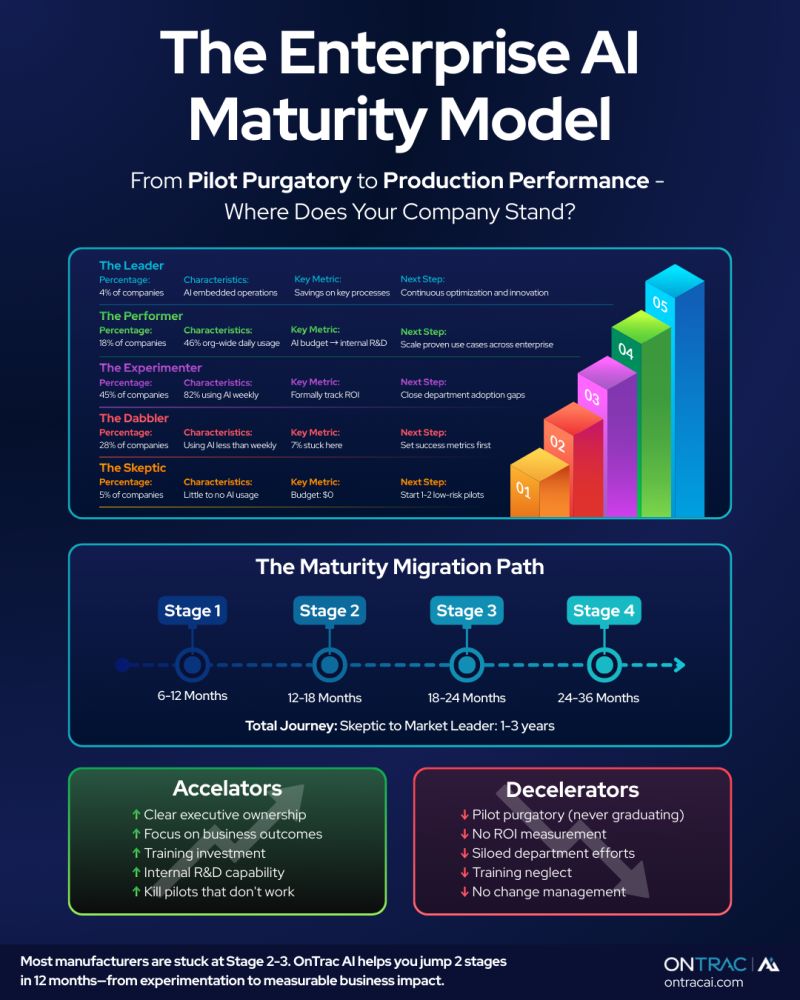
That gap is exactly why the Enterprise AI Maturity Model matters. It gives leaders a shared language to answer a simple question without handwaving: Are we experimenting or operating?
If you’re trying to connect AI solutions to real operational impact across teams, start by grounding yourself in workflows, not toys.
Why “AI adoption” isn’t maturity
Adoption is often measured by activity. How many departments have access? How many people tried the assistant? How many prompts got shared? How many prototypes exist?
Maturity is measured by reliability and outcomes. Does the AI-supported process run every week without heroics? Does it reduce cycle time, errors, or cost? Does it hold up when the inputs get messy, and the exceptions show up? Can a new employee step into the process without someone narrating tribal knowledge for two hours?
If your AI initiative depends on a few power users who know the secret sauce, you’re not mature. You’re talented. There’s a difference.
The Enterprise AI Maturity Model has five levels
Think of maturity as a climb. Each level has a different goal, a different set of risks, and a different definition of “success.”
Level 1: Curiosity and experiments
This is the “we’re exploring” stage, where teams test tools. People try AI for summarizing, drafting, and searching.
This level is useful, but it has a trap: the organization can confuse learning with progress. You’ll hear phrases like “we’re building momentum”, yet no one can point to a workflow that has changed.
The win at Level 1 is clarity. What use cases show real promise? What data and security constraints are real? Which tasks are worth automating, and which are better left alone?
Level 2: Pilots and proofs of concept
Now the company implements pilot runs, usually in a small pocket of the business. A team chooses a process, tests a model, and gets a promising result in a controlled environment.
This is where many companies stall. Not because the pilot run failed, but because production is harder than the demo. Exceptions appear. Integrations take longer than expected. Ownership gets fuzzy. Stakeholders start asking for “just one more feature” before launch.
The win at Level 2 is a decision: do we operationalize this, or do we stop? Endless AI solution pilot runs aren’t a strategy. They’re procrastinating with better branding.
Level 3: Production workflows with measurable ROI
This is the first real maturity threshold. AI isn’t just helping individuals do tasks faster. It’s supporting a workflow that has an owner, clear inputs and outputs, exception handling, and metrics.
At this stage, the organization stops talking about AI as a tool and begins to view it as a process capability. Leaders can point to something concrete: cycle time dropped, rework decreased, cash moved faster, backlog shrank, or customer response times improved.
The win at Level 3 is repeatability. If it works once but can’t be run consistently, it’s not production. It’s a fancy pilot.
Level 4: Scaled workflows across departments
Level 4 is where AI stops being a side project and becomes part of the operating rhythm. Multiple workflows run across teams. The organization standardizes how use cases are selected, built, approved, monitored, and improved.
This is also where governance starts paying for itself. Not heavy bureaucracy. Practical guardrails that prevent “random tool sprawl” and protect the business from inconsistent outputs, data leakage, or accidental commitments.
The win at Level 4 is speed with control. The company can ship workflow after workflow without having to start from scratch every time.
Level 5: AI as a managed business capability
At the top, AI is treated like any other critical capability: it has a roadmap, funding model, owners, SLAs, monitoring, and continuous improvement. Leaders don’t argue about whether AI is “real.” They argue about which workflows to prioritize next.
This is where maturity looks boring in the best way. The business runs smoothly, and AI is just part of how work gets done.
Why most organizations don’t reach maturity
The most common reason is simple: they try to scale tools before they’ve scaled workflows.
Buying more licenses doesn’t create maturity. Rolling out an assistant to everyone doesn’t create maturity. Launching an AI center of excellence doesn’t create maturity if it can’t turn ideas into production workflows with outcomes.
Maturity comes from operational muscle. Picking the right workflows. Building them with exception handling. Integrating into real systems. Measuring outcomes. Iterating. Repeating.
What maturity looks like in finance operations
If you want a fast reality check, look at finance workflows, because they’re unforgiving. The numbers either reconcile or they don’t.
In accounts receivable, “maturity” isn’t a nicer email template. It’s a system that can ingest messy remittance inputs, propose matching, route exceptions, track disputes, and reduce unapplied cash without exhausting the team.
If AR is a current pain point for your organization, it is important to identify why AR fails today and how to fix the system with AI. The reason it belongs in the maturity conversation is simple. AR shows you whether AI is changing operations or merely producing content.
The maturity leap most leaders underestimate: governance that enables speed.
Governance gets a bad reputation because people picture committees and red tape. Real maturity governance is the opposite. It’s what prevents reinvention and accelerates delivery.
At minimum, mature programs define who owns a workflow, what data can be used, how outputs are reviewed, what gets logged, and how changes are approved. They also define what happens when AI confidence is low. That’s where trust is won or lost.
This isn’t optional at scale. Without guardrails, you’ll either slow down from fear or speed up into risk. Neither one is maturity.
A practical 90-day path up the model
Most companies don’t need a multi-year transformation to move up a level. They need one production workflow that proves the playbook.
In the first month, choose a workflow that is painful, repeatable, and measurable. Define the baseline. Assign a single owner. Map exceptions early.
In the second month, build and integrate the workflow where people actually work. Keep it narrow. Ship a version one that can run weekly without heroics.
In the third month, measure outcomes and harden the exception paths. Document what worked so the next workflow doesn’t have to start from scratch.
Do this once, and the conversation changes. AI stops being a debate. It becomes a capability you can replicate.
The point of the Enterprise AI Maturity Model
The Enterprise AI Maturity Model isn’t a scorecard for bragging rights. It’s a way to stop fooling ourselves.
If your company is stuck in experiments and pilots, the next move isn’t “try harder.” It’s to pick one workflow, operationalize it, and measure it as the business depends on it.