There’s a pattern that shows up again and again when organizations start working with AI.
Many organizations say they want to be “AI-first.” Fewer understand what that actually requires.
In practice, most AI strategies fail long before the technology becomes the problem. Not because models don’t work, or data isn’t available—but because the way companies prioritize AI initiatives quietly undermines success from the start.
To understand why, consider this real scenario.
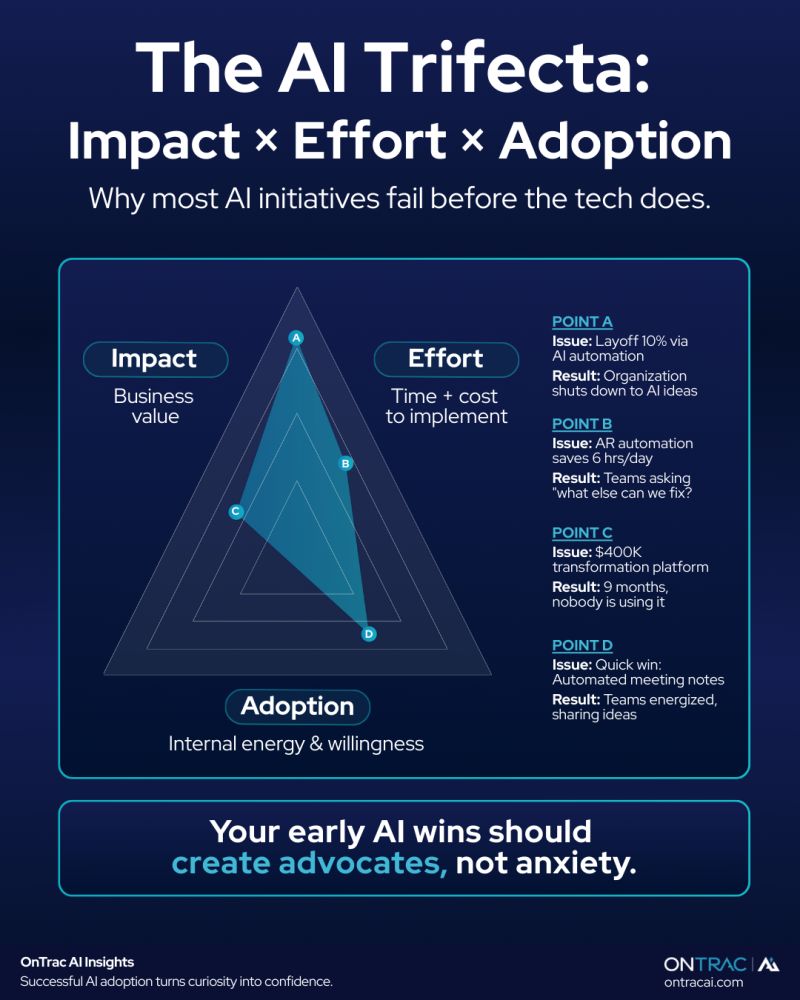
A manufacturing company went all-in on AI to leapfrog competitors. Leadership was enthusiastic. The roadmap was ambitious. The first AI project delivered exactly what it promised—automation that eliminated 10% of the workforce.
From a spreadsheet perspective, it was a win.
Three months later, something unexpected happened: no one wanted to propose the next AI initiative.
Why would they? Everyone had just watched their colleagues get walked out.
That’s when leadership realized something crucial: they had optimized for impact, but destroyed adoption.
Why the Effort vs. Impact Model Breaks Down
Most companies evaluate AI projects using a familiar framework:
- High impact, low effort → do it immediately
- Low impact, high effort → skip it
On paper, this makes sense. Resources are finite, and leadership wants ROI.
But AI is different from traditional software investments. It doesn’t just change workflows—it changes how people feel about their work, their value, and their future.
When adoption is ignored, even the best AI projects stall.
You can build something with massive business impact and reasonable technical effort, but if people don’t want to use it—or actively resist it—you haven’t created transformation. You’ve created an expensive science project.
That’s why successful AI programs rely on three dimensions, not two.
Introducing the AI Trifecta
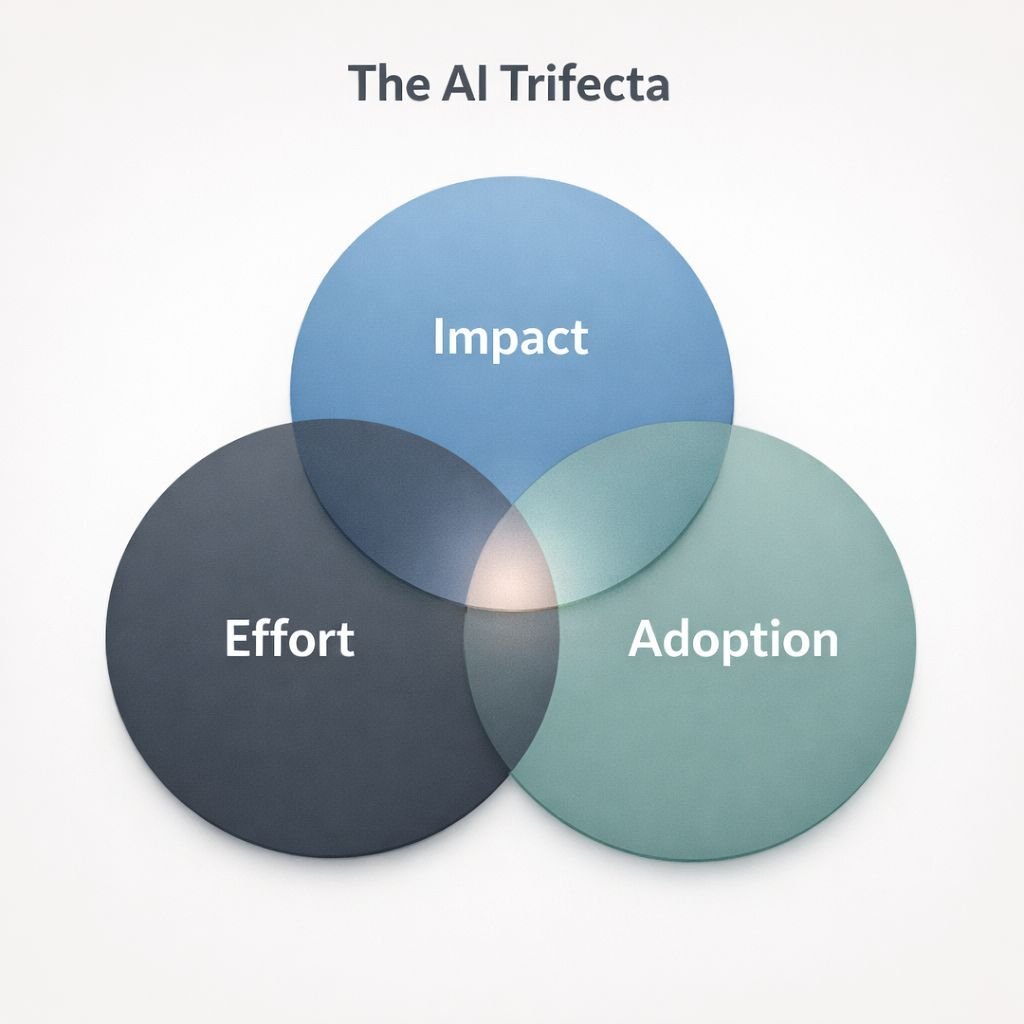
Effective AI prioritization sits at the intersection of three forces:
Impact. Effort. Adoption.
Remove any one of them, and the system breaks.
- Impact asks: Does this meaningfully move the business forward?
- Effort asks: What does it realistically take to build, deploy, and maintain?
- Adoption asks: Will people actually embrace and use this?
Most organizations underestimate the third—and pay for it later.
Adoption Is Not a Soft Metric
Adoption is often dismissed as “change management” or something that can be handled after launch. That’s a mistake.
Adoption shows up in concrete, observable ways:
- People choosing to use the tools you deploy
- Teams changing how they operate because AI makes their work better
- Employees actively looking for new opportunities to apply AI
When adoption is strong, AI spreads organically. When it’s weak, even high-impact tools remain underutilized.
The goal of early AI initiatives shouldn’t be total transformation. It should be momentum.
Momentum Beats Maximum Impact Early On
Here’s the tradeoff many leaders miss.
An accounting optimization project might save $500,000 per year by reducing headcount. From a pure ROI standpoint, it looks compelling.
But if automating expense reports gets 200 employees excited about AI—reducing friction, saving time, and sparking curiosity—which one delivers more long-term value?
The second project may have lower immediate financial impact, but it creates something far more valuable early in an AI journey: trust and energy.
Once employees see AI as a tool that helps rather than threatens them, adoption accelerates. That’s when organizations unlock the capacity to tackle bigger, more transformative initiatives without resistance.
Effort Isn’t Just Technical
Effort is often measured in engineering hours, integration complexity, or infrastructure costs. But in AI projects, effort also includes:
- Training time
- Process redesign
- Behavioral change
- Ongoing governance
A “low-effort” AI solution that disrupts roles or incentives can be far more expensive than it appears once resistance and rework are factored in.
Evaluating effort honestly—beyond just build time—keeps organizations from overcommitting too early.
Impact Compounds When Adoption Is High
High-adoption AI projects don’t just deliver their own value. They make future projects easier.
Teams become more data-literate. Leaders gain confidence. Feedback loops tighten. The organization develops muscle memory for AI experimentation.
That’s how companies move from isolated pilots to scalable AI systems.
They don’t start with moonshots. They start with wins people want to repeat.
From Framework to Execution
Applying the AI Trifecta changes how organizations sequence their AI roadmaps.
Instead of asking, “What’s the biggest thing AI can do for us?”
The better question becomes, “What creates momentum without backlash?”
That mindset leads to smarter prioritization, stronger internal buy-in, and faster compounding returns.
At OntracAI, this approach guides how we help organizations move from AI interest to real operational value—by aligning technology with people, processes, and measurable outcomes.
👉 Explore practical AI solutions designed for real adoption here
Why Most AI Programs Stall Before They Scale
When AI initiatives fail, it’s rarely because the technology didn’t work. It’s because adoption was treated as an afterthought.
Projects launched too aggressively. Fear replaced curiosity. Momentum died before it could compound.
This is exactly why many AI programs fail before they ever reach scale. For a deeper look at where AI initiatives break down early, checkout our article Why Most AI Initiatives Fail Before They Start.
The Bottom Line
AI success isn’t about choosing the biggest project or the most impressive use case.
It’s about sequencing.
The companies seeing real AI impact aren’t chasing transformation first. They’re building confidence, trust, and adoption—then using that momentum to unlock larger change.
The AI Trifecta isn’t a theory. It’s a practical lens for turning AI from a boardroom ambition into a business advantage.
Because in the long run, the AI projects that matter most aren’t the ones that look smartest on a roadmap.
They’re the ones people actually want to use.