AI in manufacturing doesn’t fail because the technology is immature. It fails when it’s applied too...

Using ChatGPT Doesn’t Make You an AI-Powered Company
We hear this constantly:
“We’re already using AI. Everyone has ChatGPT.”
That’s a good start. But it’s not transformation.
Yes, people write faster. Presentations look sharper. Teams summarize meetings more efficiently. Some small friction disappears from everyday work. These are real improvements, and they matter.
But months later, many leadership teams quietly notice something uncomfortable.
The business itself hasn’t changed.
Revenue doesn’t move differently. Operations don’t run differently. Decision-making looks exactly the same as before — just slightly faster.
This is the difference between AI adoption and AI maturity.
One improves productivity. The other reshapes how the company actually functions.
The Ladder Most Companies Don’t Realize They’re Climbing
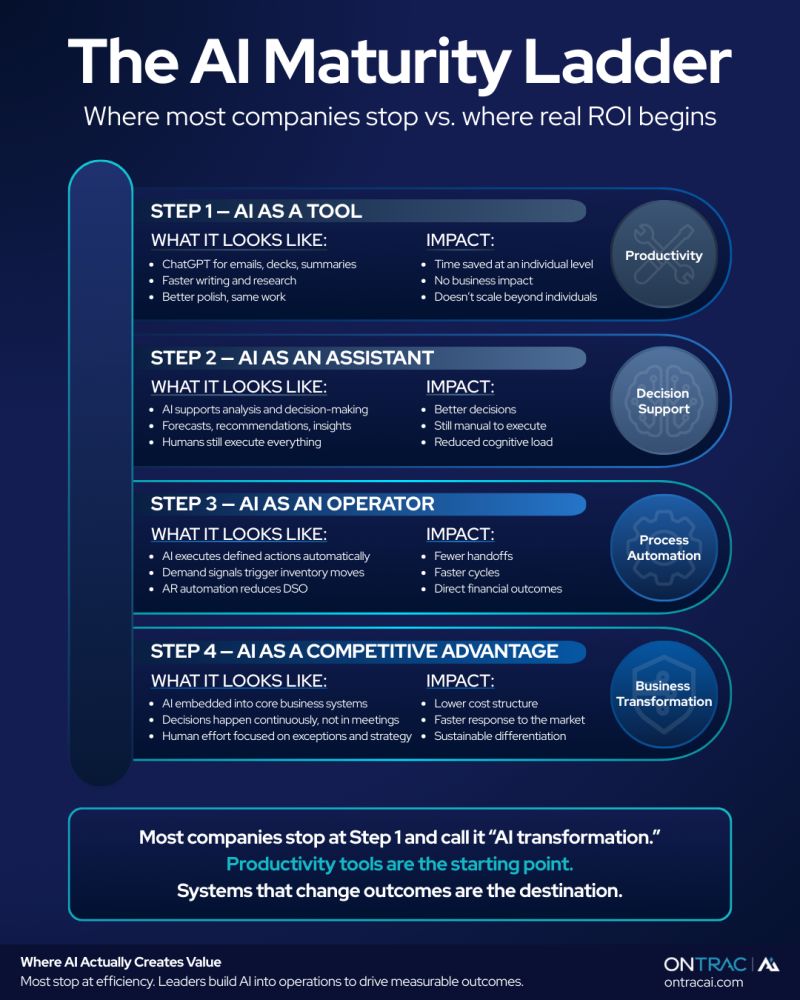
AI maturity isn’t a switch you flip. It’s a progression.
And most organizations climb only one or two steps before stopping, often without realizing it.
The early stages feel exciting because they produce visible results quickly. The later stages feel harder because they require redesigning how work happens.
That difference explains why so many companies believe they are transforming — while remaining fundamentally unchanged.
Step One: Individual Wins
The first stage is familiar.
Someone discovers ChatGPT. Another team starts using AI for drafting proposals. Analysts experiment with faster research workflows. Productivity increases quietly across departments.
Nothing is centralized yet. No strategy exists. But momentum builds because individuals see immediate value.
Leadership notices faster output and begins talking about “AI transformation.”
In reality, this is experimentation.
And experimentation is necessary — but it’s only the beginning.
Step Two: Organized Adoption
Eventually, companies attempt to standardize what started organically.
Guidelines appear. Training sessions get scheduled. Teams begin sharing prompts or best practices. Someone creates internal documentation.
This stage creates alignment, but it doesn’t change the business model.
The underlying workflows remain intact. AI sits on top of existing processes rather than reshaping them.
Many organizations stop here because progress feels visible without requiring deep operational change.
It’s comfortable.
But comfort is usually where real ROI stalls.
The Turning Point Nobody Talks About
The real shift happens when leadership stops asking:
“How do we help employees work faster?”
…and starts asking:
“Which processes actually determine revenue, profitability, or cash flow?”
That question changes everything.
Because now AI is no longer a personal productivity tool. It becomes a mechanism for changing outcomes.
Step Three: Workflow Redesign
Once organizations identify high-impact workflows, AI moves from the edges into the center.
Instead of helping individuals complete tasks faster, it begins reshaping how tasks move through the organization.
You might see:
- RFP responses partially generated and assembled automatically
- AI-assisted analysis reducing manual review cycles
- Customer inquiries routed intelligently instead of manually triaged
These changes are less visible than productivity tools but far more powerful.
They affect how teams collaborate, not just how individuals work.
And they require decisions about ownership, accountability, and measurement.
Step Four: Process Transformation
This is where the conversation shifts from tools to outcomes.
AI starts running parts of the business continuously.
Pricing adjusts dynamically. Forecasting informs purchasing decisions automatically. Accounts receivable workflows reduce delays without manual intervention.
At this stage, the organization no longer measures AI success by usage rates.
The only question that matters is impact.
Did cycle times decrease?
Did margins improve?
Did cash flow accelerate?
Companies reaching this level stop thinking about AI as a project. It becomes infrastructure.
Step Five: The AI-Native Operating Model
Very few companies reach this stage — not because it’s impossible, but because it requires sustained leadership commitment.
Here, AI isn’t introduced into workflows. Workflows are designed around AI from the beginning.
Decision-making becomes predictive instead of reactive. Routine decisions happen automatically. Human attention shifts toward strategic thinking and relationship-building.
The competitive advantage becomes difficult for others to replicate because it’s embedded in how the organization runs.
Why Most Organizations Stop Early
The honest answer is simple: transformation is uncomfortable.
Productivity tools are easy. They don’t challenge existing structures or require new accountability.
Process redesign is different.
It forces teams to rethink ownership. It exposes inefficiencies. It requires cross-functional alignment. And it demands a clear understanding of where real business value lives.
Without strategic direction, companies default back to incremental improvements because they feel safer.
Strategy Is What Moves You Up the Ladder
Climbing the AI maturity ladder isn’t about adopting more tools. It’s about choosing where to focus.
Which workflows are expensive because they rely on manual effort?
Where does delay impact revenue or customer experience?
Which decisions could run continuously instead of periodically?
These questions form the foundation of effective AI consulting and strategy work.
If your organization is exploring how to move beyond experimentation, our approach to AI consulting and strategy outlines how to identify high-impact opportunities and implement them responsibly. Learn more through our solutions page.
You may also find a useful perspective in The Dartboard: How to Define Your Perfect Customer, which explores how clarity of direction accelerates execution — a principle that applies equally to AI strategy.
Productivity Is the Starting Line
Using ChatGPT is not meaningless. It’s often the first sign that an organization is ready to evolve.
But it’s only the starting line.
Real transformation begins when AI changes workflows, not just individual output.
The companies seeing measurable ROI are not the ones with the highest tool usage. They’re the ones willing to redesign how work happens — and to treat AI as a strategic capability rather than a helpful assistant.
Where you stand on the AI maturity ladder determines whether AI remains a productivity upgrade… or becomes a competitive advantage.