A lot of companies are “doing AI” right now. Tools are everywhere. Pilots are everywhere. Internal...

Scaling Gets Easier When You Know Where to Aim
Scaling a business is rarely limited by effort. Most teams work hard enough.
The real challenge is direction.
Many companies grow slowly not because they lack opportunity, but because they try to serve too many types of customers at once. Messaging becomes diluted. Sales cycles become unpredictable. Delivery teams struggle with inconsistent expectations.
Over time, momentum slows — not from lack of demand, but from lack of clarity.
One framework we’ve used repeatedly to solve this is something we call the Dartboard.
It’s simple in concept, but powerful in execution.
Why the Dartboard Works
If you’ve ever played darts, especially games like 301, you know the strategy changes depending on where you are in the game.
Early on, hitting almost anywhere moves you forward. Progress feels easy.
But the closer you get to finishing, the more precise you need to become. If you’re sitting at five points remaining, hitting ten doesn’t help — it resets your turn.
Business growth follows a similar pattern.
Early-stage companies benefit from broad experimentation. Saying yes to many opportunities helps generate learning and momentum.
But sustained growth requires precision.
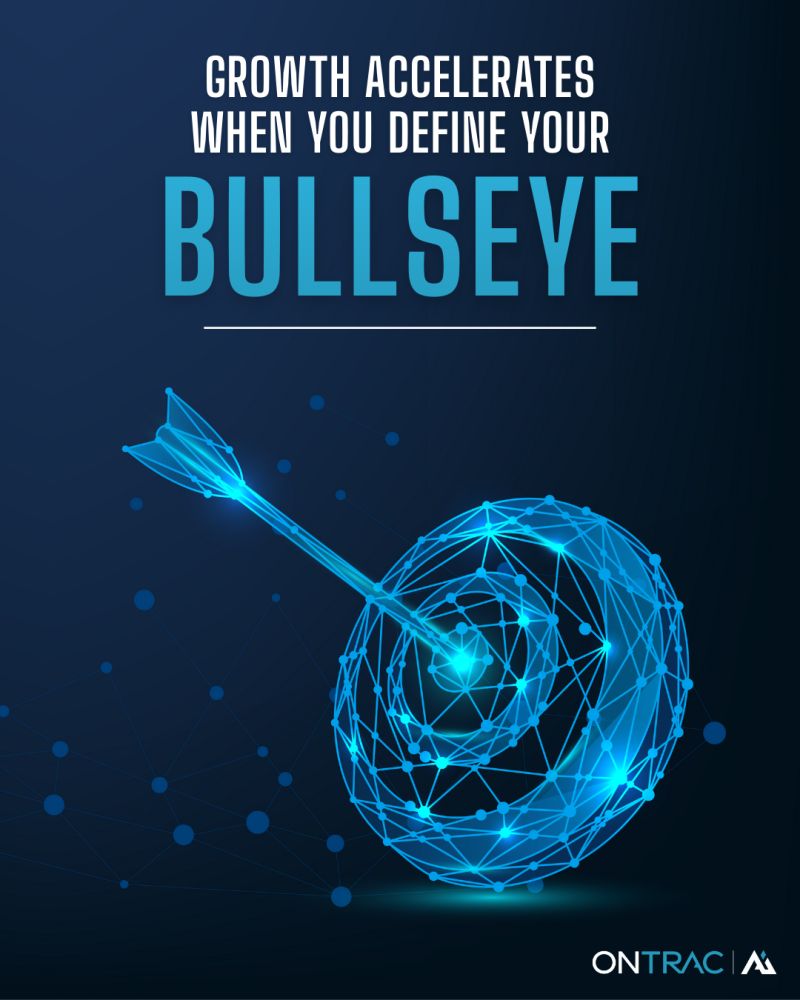
The fastest way forward isn’t chasing every possible customer. It’s defining the bullseye — the customer profile where your company delivers disproportionate value.
The Myth of “We Can Help Anyone”
Many leaders resist defining a perfect customer because it feels limiting.
“We don’t want to exclude opportunities.”
That instinct makes sense, but it often creates unintended consequences.
When a company positions itself as capable of helping anyone:
- Marketing becomes generic.
- Sales conversations become longer and less focused.
- Delivery teams face inconsistent expectations.
- Hiring becomes reactive instead of strategic.
The paradox is that trying to appeal to everyone makes it harder for the right customers to recognize you as the perfect fit.
Defining a bullseye customer doesn’t mean rejecting others. It simply means deciding where most of your attention should go.
The Bullseye Customer
Think of your dartboard as a series of concentric circles.
The outer rings represent customers you can serve.
The center represents customers you’re uniquely built to serve.
For example, at OnTrac AI, a bullseye customer might look like this:
- Manufacturing organizations
- Roughly $50M to $1B in revenue
- Leadership focused on growth rather than maintenance
- Existing systems that contain valuable operational data
- Executive teams willing to rethink workflows and adopt automation
- A mindset open to external perspective and structured change
Could we help organizations outside that profile? Absolutely.
But when it comes to messaging, hiring, training, and investment decisions, most effort is intentionally aligned around that core definition.
That focus allows everything else to become clearer.
Why Precision Accelerates Growth
When your bullseye is well-defined, several things start to change.
Marketing becomes sharper because messaging speaks directly to known challenges rather than hypothetical ones.
Sales conversations become faster because prospects recognize themselves immediately in your positioning.
Delivery improves because teams repeatedly solve similar problems and build deeper expertise.
Even hiring becomes easier. You know what experience matters because you understand the environment your customers operate within.
Over time, this creates a flywheel effect. The more focused you become, the more successful outcomes reinforce your positioning.
The Connection Between Customer Definition and AI Strategy
This concept becomes especially important when building an AI consulting and strategy practice.
AI is often framed as universally applicable — and technically, it is.
But successful implementation depends heavily on context.
Industry constraints, operational maturity, data availability, and leadership mindset all influence whether AI initiatives succeed or stall.
Trying to apply identical messaging across radically different industries dilutes credibility.
Instead, defining a bullseye customer enables:
- clearer use-case prioritization
- faster identification of high-value workflows
- more repeatable implementation frameworks
- stronger proof points through relevant case studies
If you’re exploring structured approaches to AI adoption, our solutions overview outlines how strategy and execution align to drive outcomes.
The Dartboard Evolves Over Time
One common mistake is treating the bullseye as fixed.
In reality, it should evolve.
Every successful engagement provides data. Every lost opportunity provides signals. Patterns begin to emerge:
- Which customers achieve the fastest ROI?
- Where do implementations stall?
- Which leadership styles accelerate adoption?
- What warning signs appear early in unsuccessful engagements?
Refining your dartboard means continuously tightening your definition based on real-world outcomes.
This isn’t narrowing your opportunity. It’s improving your probability of success — for both your organization and your customers.
Focus Improves Customer Outcomes
There’s another benefit often overlooked.
Precision isn’t just better for growth. It’s better for the customer.
When a company deeply understands a specific type of organization, it anticipates challenges earlier. Solutions feel less experimental and more proven. Implementation moves faster because the team has seen similar patterns before.
Customers sense this immediately.
They don’t feel like one of many possibilities. They feel like the exact customer you built your expertise around.
The Dartboard and AI Maturity
Defining your perfect customer also influences where and how you apply AI.
Organizations at different stages of AI maturity require different approaches. Some need foundational strategy and alignment. Others are ready for workflow automation or operational transformation.
If you haven’t already, read The AI Maturity Ladder, which explores how organizations progress from experimentation to true transformation — and why aligning your customer profile with maturity stage dramatically improves outcomes.
Aim Before You Throw
Growth doesn’t come from throwing more darts.
It comes from aiming deliberately.
The companies that scale most effectively aren’t necessarily the ones with the widest reach. They’re the ones that understand precisely who they serve best — and then build everything around that understanding.
Define your bullseye.
Refine it continuously.
And align your strategy, messaging, and execution so that when the right customer appears, the fit is obvious — for both sides.