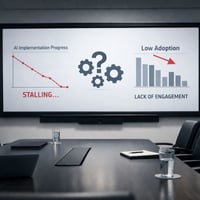
AI in manufacturing doesn’t fail because the technology is immature. It fails when it’s applied too...
AI Implementation Services Explained (Timeline, Cost, Tech Stack)

AI is no longer the hard part in scaling businesses and improving processes and systems.
Most organizations already understand that AI can improve efficiency, decision-making, or speed. What’s harder is knowing how to introduce it into real systems—without stalling teams, overcomplicating workflows, or committing to massive, long-term transformation projects.
That’s the role of AI implementation services.
Instead of focusing on theory, implementation is about execution. It’s about taking a specific business problem and turning AI into something usable, reliable, and measurable—inside the tools people already use.
This article explains what AI implementation services actually involve, how long projects tend to take, what affects cost, and how modern AI tech stacks are typically structured.
What AI Implementation Services Really Cover
AI implementation services sit between strategy and software delivery. They help organizations move from an idea to a working system by addressing practical questions that often get overlooked.
These questions usually include which processes are realistic candidates for AI, whether existing data is good enough to support those use cases, how AI outputs will fit into day-to-day work, and who owns the system once it’s live.
The goal isn’t to experiment endlessly. It’s to deliver something that people rely on—something that removes friction, improves consistency, or helps teams make decisions faster.
Why Focused AI Projects Often Deliver Better Results
One common misconception about AI is that it has to be implemented everywhere at once. In practice, many successful AI initiatives start small.
A single process or narrowly defined use case is often enough to demonstrate value, uncover constraints, and build internal confidence. Smaller projects move faster, adapt more easily, and carry less risk—especially for organizations adopting AI for the first time.
This approach also allows teams to learn how AI behaves within their specific environment before expanding further. Instead of forcing large-scale change upfront, AI becomes something that grows alongside the organization.
How AI Implementation Is Commonly Delivered
AI implementation can take different forms depending on internal capabilities, timelines, and long-term goals.
Some teams prefer flexible, short-term engagements where requirements evolve over time. Others already have engineering teams in place and need targeted AI expertise to fill specific gaps. Larger organizations may pursue broader initiatives that span multiple systems or departments.
A model that’s increasingly common is Center of Excellence as a Service (COE as a Service). Instead of building an internal AI center from scratch, organizations work with an external team that provides ongoing guidance, implementation support, and governance. This allows AI capabilities to mature without slowing execution or increasing internal overhead.
Typical AI Implementation Timelines
While no two projects are identical, most AI implementations follow a similar progression.
Early on, teams focus on defining the use case and understanding the data. This is followed by design and prototyping, where models and workflows are tested against real inputs. Once validated, the solution is productionized and integrated into existing systems. After launch, monitoring and refinement continue to ensure performance remains stable over time.
Smaller, well-scoped projects can move through this cycle quickly, especially when data is already accessible and structured.
What Makes Up a Modern AI Tech Stack
AI solutions today are rarely built around a single tool or platform. Instead, they are assembled from components chosen to support a specific outcome.
A typical AI tech stack includes:
- A data layer that supplies clean, reliable inputs
- A model layer tailored to the task being solved
- An orchestration layer that manages workflows and logic
- An application layer where results are surfaced to users
- Monitoring and governance to ensure reliability and control
The objective isn’t to chase the newest technology. It’s to build something dependable, maintainable, and aligned with how work actually gets done.
What Really Drives the Cost of AI Implementation
Cost is influenced far more by scope and readiness than by AI itself.
Projects that focus on a single process, use existing data, and integrate cleanly into current systems tend to be far more efficient. Broader initiatives—especially those requiring data restructuring or complex integrations—naturally involve higher investment.
Models like COE as a Service help balance cost and continuity by spreading effort over time while maintaining consistent oversight and delivery.
Making AI Practical, Not Theoretical
Successful AI implementation isn’t about adopting technology for its own sake. It’s about solving real problems in a way that fits the organization—not forcing the organization to adapt to the technology.
By starting with the right use case, choosing a delivery model that matches your needs, and building on a practical technical foundation, AI becomes less of a risk and more of an operational advantage.
To see how these ideas translate into real-world outcomes, explore how we integrated AI in manufacturing, or learn more about our AI solutions today.