
Using ChatGPT Doesn’t Make You an AI-Powered Company We hear this constantly:
Which AI Stage is Your Company Actually At?
Every executive wants to move faster with AI.
More automation. More efficiency. More impact.
But when asked a simple question—“Where is your company on the AI journey?”—most answers are surprisingly off.
Many organizations believe they’re further ahead than they actually are. Stage 2 companies think they’re close to Stage 4. Early adopters assume they’re scaling when they’re still experimenting.
And that gap between perception and reality? That’s where progress stalls.
Because the path forward depends entirely on where you actually are, not where you think you are.
Why Misjudging Your Stage Slows You Down
AI adoption is not linear.
What works for a company just getting started is completely different from what works for a company trying to scale AI across departments.
If you misidentify your stage, you’ll apply the wrong strategy:
- Trying to scale before proving value
- Investing in tools instead of processes
- Expecting ROI without clear metrics
- Expanding usage without governance
The result is predictable. Frustration, wasted budget, and stalled initiatives.
Clarity comes first. Then execution.
The 5 Stages of AI Adoption
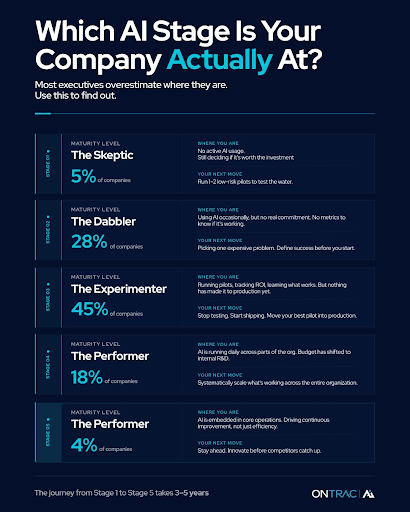
Most organizations fall into one of five distinct stages. Understanding these stages helps you identify where you are—and what to do next.
Stage 1: The Skeptic (5%)
At this stage, AI adoption is minimal or nonexistent.
There may be a few licenses for tools like ChatGPT or Claude, but there’s no structured use. Leadership is still evaluating whether AI is worth the investment.
There’s often hesitation, uncertainty, or even resistance.
What’s happening:
- Little to no AI usage
- No dedicated budget
- No defined use cases
What to do next:
Start small. Identify one or two low-risk use cases where AI can deliver quick wins. The goal is not transformation—it’s validation.
Stage 2: The Dabbler (28%)
This is where many companies believe they’re more advanced than they are.
AI is being used regularly, but mostly for low-impact tasks—content drafting, basic automation, or internal experimentation.
There’s activity, but not direction.
What’s happening:
- Teams using AI inconsistently
- No clear success metrics
- Limited business impact
What to do next:
Define success. Tie AI efforts to measurable business outcomes—cost reduction, time savings, revenue growth. Then prioritize use cases that directly influence those metrics.
Stage 3: The Experimenter (45%)
This is where momentum builds.
Companies in this stage are actively testing AI across multiple use cases. They’re tracking ROI, learning what works, and refining their approach.
AI is no longer a curiosity—it’s a strategic initiative.
What’s happening:
- Regular AI usage across teams
- Formal tracking of results
- Multiple pilots in progress
What to do next:
Move from pilot to production. Identify the use cases that consistently deliver value and begin operationalizing them.
This is also where many organizations get stuck.
Stage 4: The Performer (18%)
At this stage, AI is no longer experimental—it’s operational.
Successful use cases are being scaled across teams or departments. AI usage becomes part of daily workflows, and investment shifts toward internal development and optimization.
What’s happening:
- Widespread, consistent usage
- Proven use cases deployed at scale
- Dedicated resources for AI initiatives
What to do next:
Scale with discipline. Expand successful implementations across the organization while maintaining quality, governance, and performance.
Stage 5: The Leader (4%)
This is where AI becomes a true competitive advantage.
AI is embedded into core operations. It’s not just improving processes—it’s reshaping them. Organizations at this stage are continuously optimizing, innovating, and staying ahead of the curve.
What’s happening:
- AI integrated into critical workflows
- Continuous improvement cycles
- Measurable impact on business outcomes
What to do next:
Stay ahead. Maintain your advantage through ongoing innovation, monitoring, and refinement.
The Real Bottleneck: Stage 3 to Stage 4
The biggest challenge in AI adoption is not getting started.
It’s scaling.
Moving from experimentation to production is where most companies struggle. They have promising pilots, but can’t translate them into reliable, repeatable systems.
Why?
Because the gap between Stage 3 and Stage 4 isn’t about technology.
It’s about execution discipline.
This includes:
- Standardizing processes
- Ensuring data quality
- Implementing validation frameworks
- Aligning teams and workflows
- Managing change across the organization
Without these, pilots stay pilots.
The Timeline Most Companies Underestimate
The journey from Stage 1 to Stage 5 doesn’t happen overnight.
For most organizations, it takes 3 to 5 years to move from skepticism to full-scale AI integration.
Trying to shortcut this process often leads to poor outcomes—rushed implementations, unclear ROI, and systems that don’t scale.
Progress requires patience, but more importantly, it requires structure.
Why Stage Awareness Changes Everything
When you clearly understand your stage, decision-making becomes easier.
You know:
- What to prioritize
- What to ignore
- Where to invest
- How to measure success
Instead of chasing trends, you follow a roadmap that fits your current reality.
And that’s what drives real progress.
What AI Stage Are You Currently In?
Most organizations are not as advanced as they think.
And that’s not a problem.
In fact, recognizing where you truly are is the most important step forward.
Because once you’re honest about your starting point, you can build a strategy that actually works.
Moving Forward with Clarity
AI success isn’t about jumping stages.
It’s about moving through them deliberately.
If you’re looking to accelerate your progress and move from experimentation to scalable impact, explore how structured AI implementation can support your journey.
And if you’re thinking about what AI at scale really looks like, consider this: What would you do with 25 AI employees?
The companies that succeed with AI aren’t the ones that move the fastest.
They’re the ones that move forward with clarity, discipline, and the right strategy for where they actually are.