
For the past year, a familiar narrative has resurfaced: the AI boom looks just like the dot-com...
Turning Overwhelming Data Into Revenue With AI | OnTrac AI
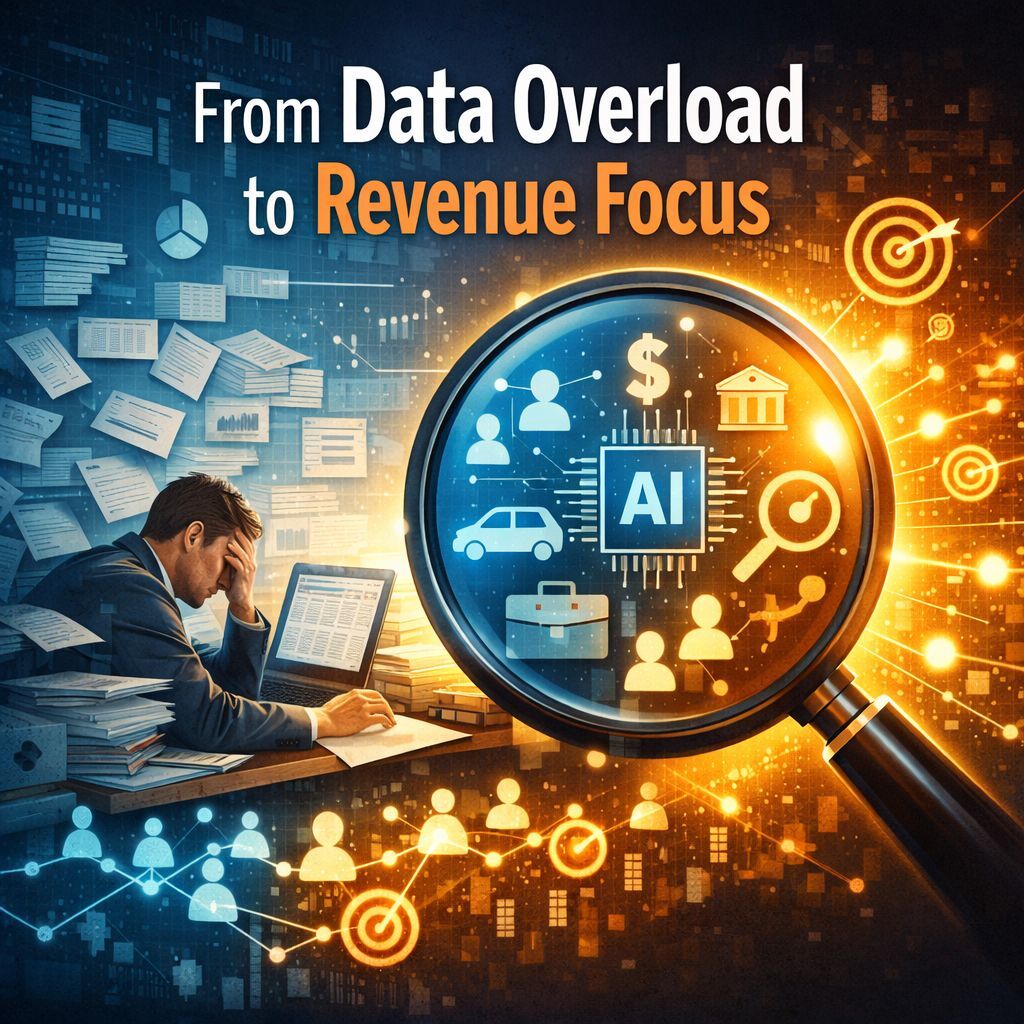
In the last few days, I’ve had conversations with executives across three completely different industries.
Automotive.
Finance.
Legal.
Different businesses. Different markets. Different pressures.
But the constraint they described was almost identical.
They all had access to more data than they knew what to do with — thousands of potential leads coming from third-party sources, internal systems, or years of accumulated customer history. And despite that abundance, revenue opportunities were quietly slipping through the cracks.
Not because teams lacked skill or motivation.
Because they were overwhelmed.
When Data Stops Being Helpful
There’s a common assumption that more data automatically leads to better decisions.
In reality, the opposite often happens.
As data grows, clarity decreases.
One automotive company had access to information about nearly every vehicle purchased across its market, along with years of internal purchase history. On paper, that’s an enormous advantage. In practice, the data lived in separate systems, structured differently, and required manual effort to connect.
Someone had to export reports.
Someone had to filter spreadsheets.
Someone had to decide which signals actually mattered.
And most of the time, that “someone” didn’t have enough hours in the day.
The result wasn’t inefficiency — it was missed opportunity.
The Hidden Cost of Manual Lead Discovery
The same pattern showed up in finance.
An executive described spending hours each month reviewing third-party datasets for potential investments. Rows of numbers, filters, manual sorting — all necessary work, but slow and repetitive.
Legal firms face similar challenges. Case types, historical outcomes, potential client signals — all stored across multiple databases that don’t naturally speak to each other.
The issue isn’t access to data. It’s the gap between having information and being able to act on it quickly.
When every lead looks roughly the same, teams default to manual prioritization. They rely on intuition, experience, or whatever feels manageable at the moment.
And when that happens, growth doesn’t stop abruptly — it just quietly slows.
The Opportunity Sitting Inside the Noise
What these organizations actually need isn’t more data.
They need a way to make sense of what they already have.
One way to think about it is a “Seek, Score, and Synthesize” system — something designed around the realities of the business rather than generic analytics dashboards.
First, the system seeks: pulling signals from internal and external sources automatically.
Then it scores: identifying which opportunities resemble past successes, which signals indicate urgency, and where the probability of conversion is highest.
Finally, it synthesizes: presenting insights in a way that makes decision-making easier instead of more complex.
This doesn’t replace human judgment. It gives teams a starting point that’s already filtered and prioritized.
Instead of staring at a spreadsheet with hundreds of rows, they begin with a shortlist that actually deserves attention.
Why AI Changes the Equation
Before AI became practical at scale, building something like this required significant manual effort or custom engineering.
Today, AI makes it possible to analyze patterns across massive datasets quickly — spotting relationships that would otherwise remain hidden.
The value isn’t in automation alone. It’s in discovery.
The highest-value opportunities are rarely obvious. They’re buried deep in datasets — row 374, row 423 — signals that don’t stand out until they’re compared against historical patterns and contextual data.
AI helps surface those signals.
It finds similarities between current leads and past customers. It identifies timing patterns. It highlights where engagement is likely to succeed now, not later.
And that changes how teams spend their time.
From Data Overload to Revenue Focus
The companies that move fastest aren’t necessarily those with the most advanced technology. They’re the ones that shift their mindset.
Instead of asking, “How do we process all this data?” they ask, “How do we turn this data into decisions?”
That shift sounds subtle, but it reframes the goal.
The goal isn’t to build a perfect dataset. It’s to identify revenue opportunities earlier and more consistently.
For some organizations, that means improving lead prioritization. For others, it means uncovering entirely new segments that were previously overlooked.
Either way, the outcome is the same: less time searching, more time executing.
Where Most Organizations Get Stuck
Interestingly, the barrier isn’t usually cost or access to technology.
It’s uncertainty about where to begin.
Teams know the opportunity exists, but they struggle to translate it into a practical starting point.
If that sounds familiar, you’re not alone. Many organizations face the same question, which is why defining an initial use case matters more than building a comprehensive system upfront.
If you’re exploring how to identify that AI starting point, we have discussed this topic in another post to offer additional perspective.
Turning Insight Into Action
Ultimately, turning data into revenue isn’t about dashboards or reports. It’s about clarity.
Which opportunities matter right now?
Why do they matter?
What should the team do next?
AI becomes valuable when it answers those questions in a way that fits how the business actually operates.
Organizations that implement this well often find something surprising: they weren’t lacking opportunities. They were lacking visibility.
And once visibility improves, growth follows naturally.
If you want to explore how structured AI solutions help organizations connect data with measurable outcomes, read more about our services and let’s start the discussion.
Final Thought
Most companies already have the raw material they need for growth.
The next customers.
The next deals.
The next opportunities.
They’re already there — hidden inside datasets waiting to be understood.
The real challenge isn’t finding more data.
It’s finding the signal that matters, before someone else does.