
In the automotive world, suppliers play a vital but complex role. They are the behind-the-scenes...
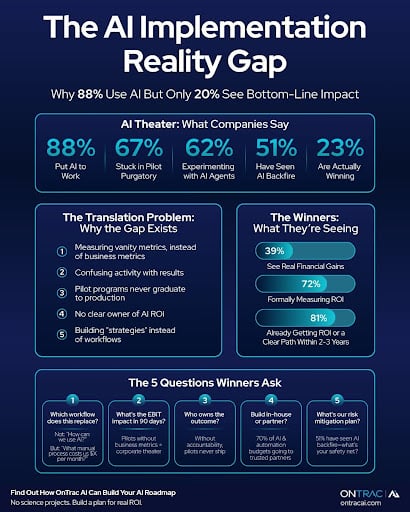
Artificial intelligence has reached mass adoption, 88% of companies say they’ve already “put AI to work.”
Yet only 20% are seeing real bottom-line impact.
That gap isn’t just a technical issue. It’s a business problem, one that’s costing organizations millions in wasted investment, stalled initiatives, and teams stuck in experimentation mode with nothing meaningful to show for it.
At OnTrac AI, we see this pattern again and again: leadership launches an AI solution, tools get purchased, excitement builds… and six months later, operational workflows look exactly the same.
So why does it keep happening? And more importantly, what are the winning companies doing that others aren’t?
Let’s break it down.
The AI Theater Problem: Everyone Is Busy, But Few Are Advancing
Many organizations are investing heavily in AI, but the outcomes aren’t matching the effort.
According to industry data:
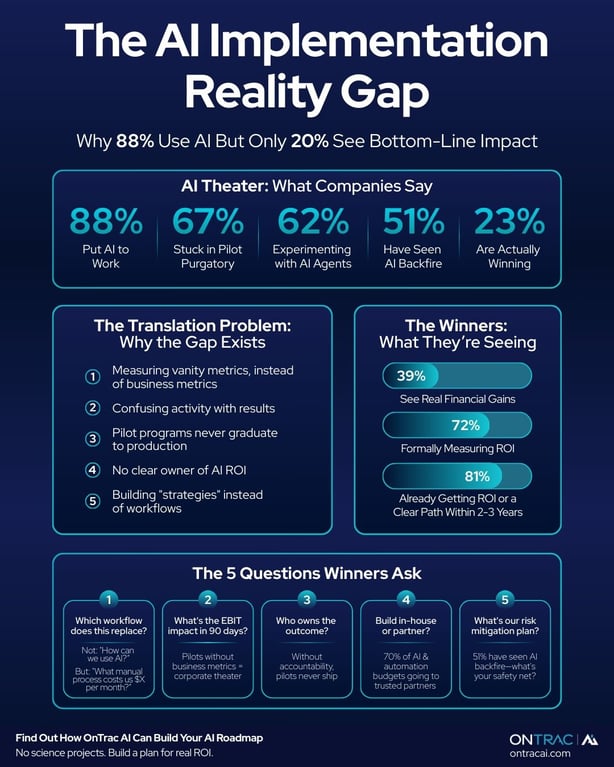
- 67% are stuck in pilot purgatory
- 62% are still “experimenting” with AI agents
- 51% have experienced an AI initiative backfiring
- Only 23% are seeing true, scalable impact
In other words: Many businesses are in the AI life cycle, but actual transformation is rare.
The reason? Most companies confuse activity with progress.
They celebrate the number of AI tools deployed, the hours spent on pilot testing, or the impressive strategy decks circulating in meetings. But none of these measure whether the business is actually making more money, reducing costs, or operating more efficiently.
Companies are measuring vanity metrics instead of business metrics.
Why Most Companies Don’t See ROI from AI
Across hundreds of conversations with executives, operations leaders, and technical teams, five root causes show up consistently.
Pilots Don’t Graduate to Production
Teams test promising ideas but never define how the pilot becomes a real workflow. Without a path to scale, pilots remain science projects.
No Clear Owner of AI ROI
If nobody is accountable for outcomes, nothing ships. AI becomes “everyone’s job”—which means it’s effectively no one’s job.
AI Strategies Are Built Like Slide Decks, Not Workflows
Organizations focus on “AI strategy” instead of answering the real question: Which manual process does this replace?
Until AI ties directly to revenue, cost reduction, or capacity gains, ROI will remain elusive.
Teams Celebrate Activity Instead of Outcomes
"We deployed 15 AI tools" is not a KPI. If the workflow didn’t change, the business didn’t change.
Metrics Don’t Connect to Financial Impact
Companies track usage, adoption, prompt counts—but not EBIT, cycle time, or unit economics.
AI only creates value when it impacts operations, cost structure, or decision quality.
Meanwhile, the Top Performers Are Seeing Real Gains
The organizations that are winning with AI share a very different profile:
- 39% report immediate financial gains
- 72% are formally measuring ROI
- 81% already see returns or have a clear path within 2–3 years
Top performers aren’t deploying more tools—they’re deploying better questions.
What Winning Companies Do Differently
At OnTrac AI, we’ve found that successful organizations ask five critical questions before they build anything.
1. “Which workflow does this replace?”
Not: “How can we use AI?”
But: “What manual process costs us $X per month—and how do we automate it?”
Top performers map the current process, quantify the time and cost, and define what “done” looks like once AI is in place. If they can’t point to a clear before-and-after workflow diagram, they don’t greenlight the project. This reframes AI from experimentation into direct operational value.
2. “What’s the EBIT impact in 90 days?”
AI projects should not take a year to show value. Fast-cycle ROI is the new standard.
Winning companies design initiatives as 90-day sprints with a concrete financial hypothesis: “Reduce handling time by 30%,” “Eliminate 2 FTEs worth of low-value work,” or “Cut error rates enough to avoid $X in rework”.
They don’t expect the entire enterprise to be transformed in three months—but they do expect a measurable signal that EBIT, margin, or unit economics are moving in the right direction. If they can’t articulate a 90-day impact story, they treat it as a nice idea, not a funded project.
3. “Who owns the outcome?”
Without an accountable owner, pilots will never ship.
High-performing organizations assign a single business owner—not just a technical sponsor—who is responsible for the result. That person is accountable for adoption, process change, and the KPIs that move, not just the model that works in a demo.
These businesses often build a small cross-functional squad around this owner (ops, tech, finance) and give them permission to change workflows, update SOPs, and retire legacy steps. AI is no longer “everyone’s job,” which means it finally becomes someone’s job to deliver the outcome.
4. “Do we build in-house or partner?”
70% of AI automation budgets now go to trusted partners because speed to impact matters more than owning the code.
Top performers evaluate partners on three things: time to first ROI, ability to integrate with existing systems, and willingness to co-own business outcomes, not just deliver a technical solution.
The question isn’t “Can we build this?” but “Is building this the best use of our limited talent and time?”
5. “What’s our risk mitigation plan?”
51% of companies have seen AI backfire. The winners prepare for this from day one.
Instead of bolting on governance at the end, leading organizations bake risk management into the design.
They define failure modes upfront (bad outputs, biased decisions, compliance gaps, customer confusion) and put clear guardrails in place: human-in-the-loop checkpoints where needed, audit logs, escalation paths, and rollback plans.
They pilot in controlled environments, monitor real-world performance, and adjust thresholds before scaling. This doesn’t slow them down—it gives executives the confidence to move faster because the downside is understood and managed.
These questions force clarity. They turn AI from a tech initiative into a business engine.
The Shift: From AI Strategy to AI Execution
Most companies are still stuck planning. Top performers are shipping AI-powered workflows that:
- Automate repetitive operational tasks
- Remove manual bottlenecks
- Improve pricing, forecasting, or revenue cycles
- Decrease error rates
- Increase throughput without increasing headcount
They aren’t chasing the most tools—they’re targeting the highest-value workflows.
That is where ROI lives.
Where Does Your Organization Stand?
If your AI program has stalled, you’re not alone.
But the gap between experimenting and achieving real impact is smaller than it looks—if you shift your focus from tools to workflows, from pilots to production, and from activity to measurable business value.
The winners are already building their advantage. The question is: Are you?
If you want to turn AI into a real driver of efficiency, margin improvement, and bottom-line impact, OnTrac AI can build your roadmap—one that ships, scales, and shows measurable ROI.
No theater. No science projects. Just results.