
A lot of businesses want to embrace AI, whether through back-office automation, a front-end AI...

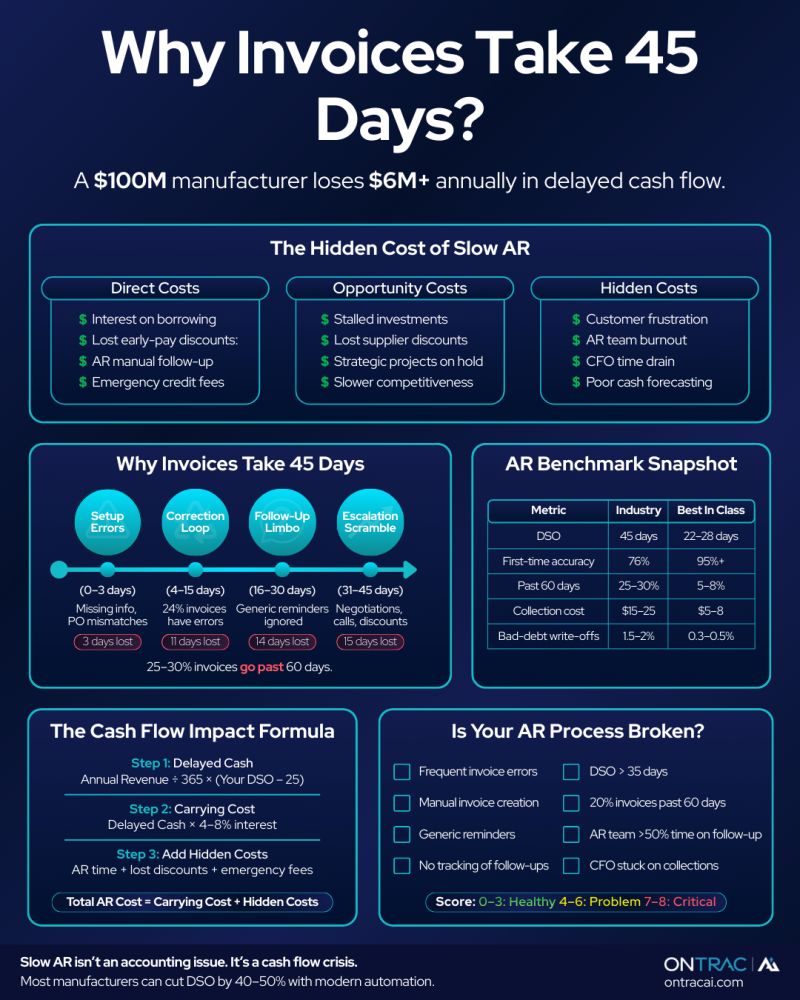
If you’ve ever asked, “Why invoices take 45 days?” you’re probably not asking because you love accounting trivia. You’re asking because cash is moving like it’s stuck in traffic… and everyone is pointing fingers at everyone else.
Sales says the customer is slow. Ops says the paperwork wasn’t ready. Finance states the invoice was sent late. The customer says they never received the right documents. Somebody swears the invoice was “submitted in the portal.” Two weeks later, you discover it was submitted, but not in the right section of the portal. Classic.
Here’s the blunt answer: invoices don’t take 45 days because your team is lazy or undertrained. Invoices take 45 days or more to close because the process is built to create delays, rework, and ambiguity.
If you want to see what “fix the workflow, not just the symptoms” looks like across operations, OnTrac AI Solutions is a good place to start, because invoicing is usually one piece of a bigger workflow puzzle, not a standalone problem.
The real cost of a 45-day invoice cycle
When people talk about long invoice cycles, they often treat them like an inconvenience. It’s not. It’s a quiet profit leak.
A slow invoice cycle means you’re effectively lending money to your customers interest-free, while you still have to pay payroll, suppliers, and overhead on time. In manufacturing, that cash pressure doesn’t stay politely in finance. It spills into production decisions, purchasing, and even customer service.
This is why an invoice taking 45 days or more to process isn’t an accounting problem. It’s an operating model question.
Why invoices take 45 days in the first place
Most invoice delays aren’t caused by one big mistake. They’re caused by many small handoffs that get stuck.
Reason 1: “Invoice ready” is a moving target
In a perfect world, invoicing is simple. You ship, you invoice, you get paid.
In the real world, “ready to invoice” depends on a checklist that’s often spread across departments: proof of delivery, customer reference numbers, receiving confirmation, pricing validation, contract terms, change orders, freight details, and whatever else that specific customer decided matters this quarter.
When that checklist lives in people’s heads or is scattered in emails, your invoice doesn’t just get delayed. It gets delayed quietly. Nobody knows it’s stuck until someone asks why cash is late.
Reason 2: Exceptions are normal, but your process treats them like emergencies
Most manufacturing billing isn’t clean. There are partial shipments, substitutions, price changes, backorders, rush freight, split POs, returns, credits, and “special handling” that applies only to certain accounts.
If exceptions require heroics every time, such as manual research, hunting attachments, chasing approvals, you don’t have an invoicing process. You have an exception firefighting routine.
And firefighting always loses to volume.
Reason 3: Customer portals create invisible work
Portals are where invoices go to age.
Not because portals are evil, but because portals add steps: log in, find the right customer, upload in the right place, attach the right docs, use the right naming convention, and then hope the portal accepts it without a cryptic error message.
If your invoicing success depends on someone remembering “this customer wants the POD uploaded under a different tab,” invoices will take 45 days. Not always. Just often enough to hurt.
Reason 4: Sales-to-finance handoffs are messy
This one’s touchy, but it’s real.
Pricing and terms are agreed in sales conversations. Then, finance tries to invoice based on what’s in the system. If the system isn’t updated, finance invoices wrong—or delays invoicing to verify—then the customer disputes, and the clock resets.
This is one of the most common hidden causes behind “Why Invoices Take 45 Days?” The invoice isn’t late because people are slow. It’s late because the deal's truth didn’t cleanly make it into the billing workflow.
Why “hire more people” doesn’t solve it
When invoice cycles drag, some organizations respond by throwing labor at the problem. More billing clerks. More coordinators. More analysts to chase documents.
That can help in the short term, but it rarely fixes the core issue. It usually creates a bigger version of the same system: more handoffs, more inconsistencies, more tribal knowledge, and more time spent reconciling who did what.
If the workflow is fragmented, headcount becomes a treadmill. You run harder and still end up facing the same problem repeatedly.
How AI fixes the invoicing system
AI helps most when it’s used as workflow glue—not as a fancy writing tool or a random add-on. The point is to reduce the time spent chasing, checking, reformatting, and re-uploading.
Step 1: Turn invoice readiness into a visible workflow
Instead of “someone will let us know,” AI can help assemble invoice readiness signals from the places they already live: shipping documents, ERP events, portal confirmations, customer-specific requirements, and exception notes.
When readiness becomes visible, work stops hiding. That alone cuts days.
Step 2: Automate document gathering and validation
A big chunk of invoice delay is document scavenger hunting. AI can help pull the right attachments, check that required fields are present, and flag what’s missing before the invoice goes out.
That prevents the painful loop where the customer rejects the invoice, asks for backup, and your team has to start over.
Step 3: Route exceptions to the right owner with context
Exceptions shouldn’t land in a generic queue where they wait for someone to have time to investigate.
AI can classify common exception types and route them to the right person with the relevant context attached. Not “here’s the problem, good luck.” More like “here’s what’s missing, here’s where it likely lives, and here’s what needs approval.”
That’s the difference between an exception taking two hours vs. two days.
Step 4: Standardize portal submissions without making people hate their lives
Portal work is repetitive, rules-based, and easy to mess up. That’s exactly the kind of work automation should handle.
AI-supported workflows can standardize how invoices and backup docs are packaged, named, and submitted—so success doesn’t depend on someone remembering customer-specific quirks under deadline pressure.
The maturity problem hiding inside invoicing delays
If your invoicing process depends on heroics, you’re not dealing with an “invoice issue.” You’re dealing with an implementation issue.
This is exactly what the AI implementation reality gap is about: teams have AI tools, but the work still isn’t running end-to-end.
Invoicing is a great test case. It’s repeatable, measurable, and unforgiving. You either speed up cash flow by optimizing business processes or you don’t.
What changes when you fix the workflow
When you solve the real drivers behind why your invoices take 45 days, the improvements are surprisingly unglamorous, and that’s the best part.
Invoices go out sooner because readiness is clear. Rejections drop because documentation is complete. Disputes shrink because terms and pricing are consistent. Portal submissions stop being a mystery. And finance spends less time chasing and more time controlling the process.
That’s not just better billing. That’s better operations.
.jpg?height=200&name=memento-media-2pPw5Glro5I-unsplash%20(1).jpg)